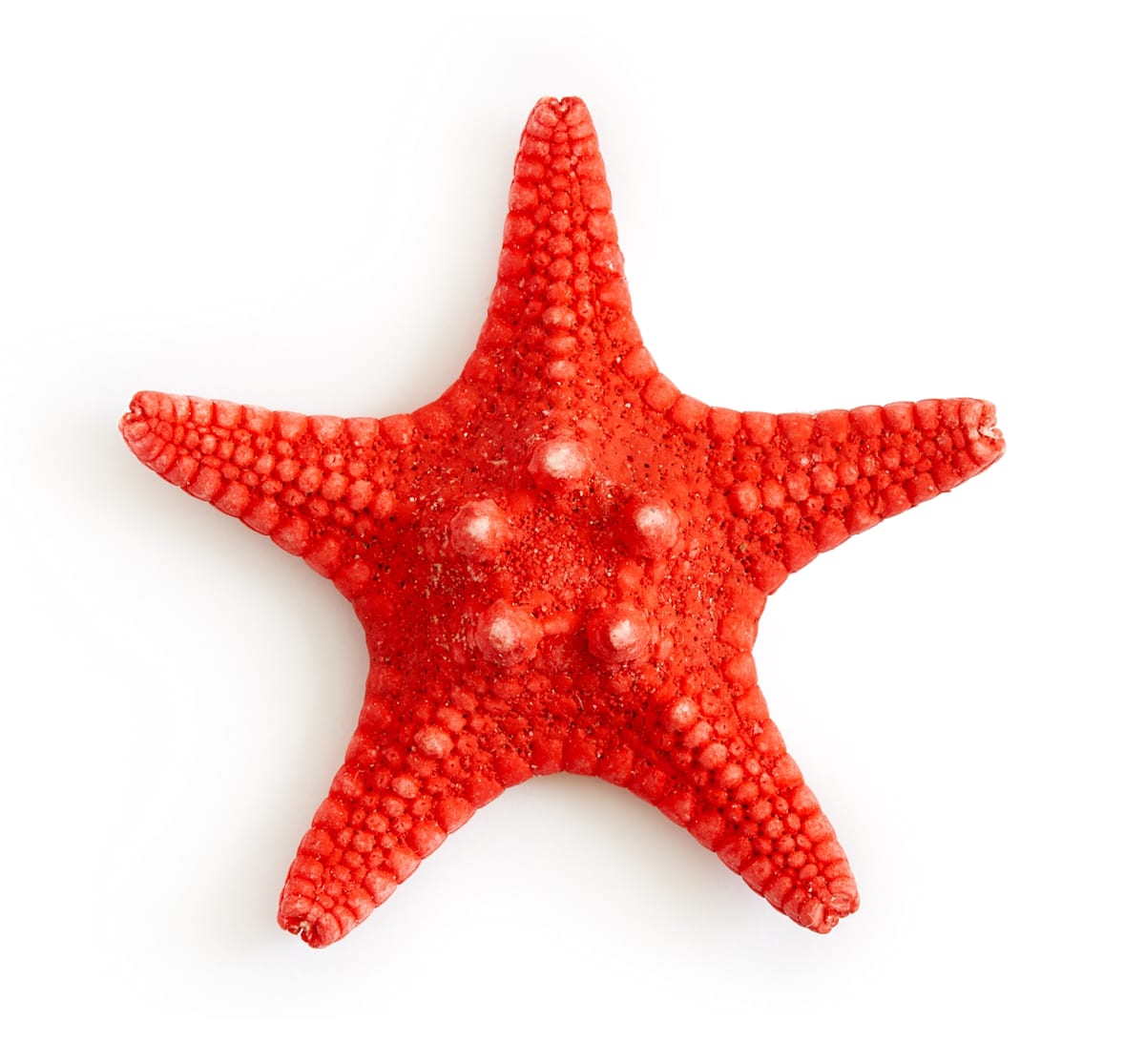
This care sheet covers a variety of starfish, including:
- Chocolate chip starfish
- Sand-sifting starfish
- Red knob starfish
- Red luzon starfish
- Blunt spine brittle starfish
- Red linckia starfish
- Green brittle starfish
- Red marble starfish
Typical appearance and behavior
- In most species, starfish have five arms, giving them their star-shaped appearance and come in many colors including yellow, red and purple
- Through fragmentation, starfish can regenerate their limbs, and some can reproduce by breaking off one of their legs and growing a new starfish.
- Starfish have a system of tube feet underneath their bodies and a foot like a suction cup that is used to secure themselves onto a surface, except for sand-sifting and brittle starfish; their tube feet do not have a suction cup
- Most species eject their stomach out of their body, enabling the stomach to surround and digest the prey outside of their body.
- Tanks should have plenty of hiding places and substrates for starfish to explore.
- They require extremely stable water quality, specific gravity, and water temperature to replicate their natural habitat.
- They are slow movers and spend most of their time exploring for food.
Characteristics
| Care difficulty | Beginner to advanced, depending on species |
| Average Life Span | Up to 35 years with proper care, depending on species |
| Average adult size | Depends on species |
| Diet | Omnivorous or carnivorous, depending on species |
| Minimum habitat size | 10+ gallons, depending on species |
| Water temperature | 74–80°F |
| Specific gravity | 1.023–1.025 |
Habitat
Habitat size
A minimum of 10+ gallons is recommended for starfish; however, water conditions can change rapidly in smaller water volumes. A larger aquarium is recommended for larger starfish species.
Building your habitat
- Water health -
- Provide proper filtration to ensure optimal water quality to help maintain health
- Provide slow to strong water circulation, depending on species, to mimic water currents found in the starfish's natural habitat
- Stable water quality (pH, ammonia, nitrate, nitrite) and water temperature are critical to the health of aquatic life
- If you are unsure of your water quality, bring a sample to Petco for free testing
- A protein skimmer can help maintain great water quality and high dissolved oxygen levels
- An aquatic heater should be used to stabilize water temperature, ensuring it does not fluctuate more than +/-2 degrees in a 24-hour period. The specific gravity should remain stable. Do not allow specific gravity to fluctuate more than +/-0.001 in a 24-hour period.
- Provide rock and décor for hiding places and plenty of room for movement
- Live rock can provide a natural food source while also enhancing biological filtration
Feeding
A well-balanced starfish diet consists of:
- Many starfish are carnivores and feed primarily on commercial meaty fresh, frozen, freeze-dried and pelleted foods; some species of starfish are omnivores and also feed on algae
- Vitamins or trace minerals can be beneficial to all marine inverts
- Some species of starfish are known to feed on corals
Things to remember when feeding your starfish:
- Feed 2–3 times per week, depending on species
- Thaw frozen food before feeding
Starfish care
- Water care: Maintaining great water quality with regular water changes and adequate filtration is important to help keep your starfish healthy
- Daily: Check filter, water temperature, specific gravity and other equipment
- Weekly: Check water quality at least once a week.
- Monthly: Change 10–25% of the total volume of water every 2–4 weeks, or as needed; change filter media monthly
Where to buy
In store only. Starfish are available for purchase at your local Petco Pet Care Center location; availability varies by location. Please call ahead to check availability.
Supplies
- Appropriately sized aquarium
- Appropriate food, dry and frozen
- Décor
- Water conditioner
- Marine aquarium salt
- Filter
- Water test kit
- Full-spectrum lighting
- Net
- Thermometer
- Protein skimmer
- Marine substrate
- Heater
- Refractometer
- Live rock
Tank mates
- Dwarf and large angelfish
- Anthias
- Basslets
- Blennies
- Butterflyfish
- Cardinals
- Clownfish
- Damsels
- Dartfish
- Dragonets
- Filefish
- Foxface/rabbitfish
- Gobies
- Hawkfish
- Pseudochromis
- Reef-safe wrasses
- Tangs
Introduce new inhabitants to the aquarium gradually.
Health
Signs of a healthy starfish
- Bright, even coloring
- All starfish arms are intact
- Active when feeding
Red flags (if you notice any of these signs, contact your local aquatic specialist or aquatic veterinarian)
- Loss of color or appetite
- Missing or deteriorating arms
- Open sores or dissolving tissue
Common starfish health issues
Little is known about diseases that affect invertebrates; as long as environmental conditions and food supplies are adequate, invertebrates are fairly resistant to disease.
FAQs
- Where can I buy starfish? Various starfish are available at your local Petco store. Availability varies by location; please call ahead to check availability.
- What do starfish eat? Depending on the species of starfish, they can be omnivores or carnivores, feeding on a variety of fresh, frozen, freeze-dried and pelleted meaty foods. Omnivorous starfish can also be offered algae.
- How long do starfish live? Starfish can live up to 35 years with proper care, depending on the species.
- Is starfish a fish? Starfish are not fish. Starfish do not have a brain, gills, scales or blood, but they do have a complex nervous system.
- How do starfish eat? Starfish expel their stomach out through their mouth, surrounding and digesting their food.
Notes and resources
Ask a Pet Care Center associate about Petco's selection of products available for the care and happiness of your new pet. All products carry a 100% money-back guarantee.
Because all aquatic life are potential carriers of infectious diseases, such as atypical mycobacterium and salmonella, always wash your hands before and after handling your aquatic life or habitat contents to help prevent the potential spread of disease.
Pregnant women, children under the age of 5, senior citizens and people with weakened immune systems should contact their physician before purchasing or caring for aquatic life and should consider not having aquatic life as a pet.
Go to the Centers for Disease Control at cdc.gov/healthypets for more information about aquatic life and disease.
The information on this care sheet is not a substitute for veterinary care. If you need additional information, please contact your veterinarian as appropriate.