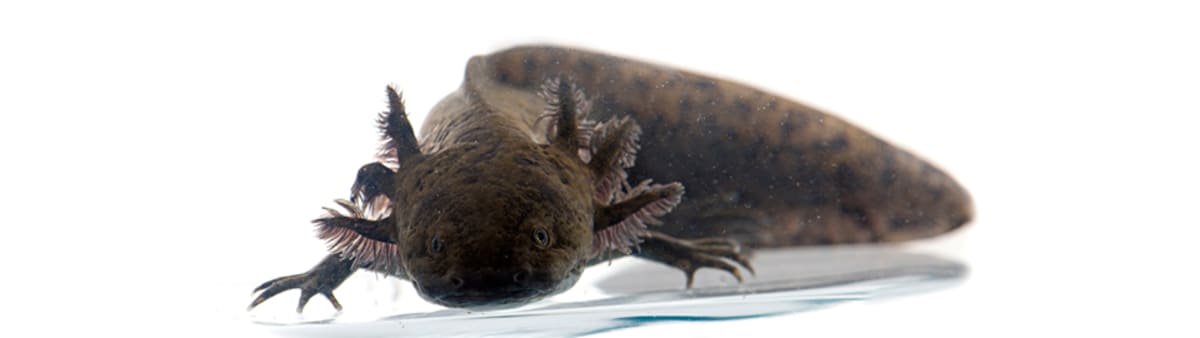
Typical Axolotl appearance and behavior
- Has frilly gills
- Lives permanently in water Is not very active, tends to rest on bottom of the aquarium
- Is referred to as “the walking fish”
- Can regenerate a limb
- Is a voracious carnivore
- Nocturnal
- Comes in different color morphs
- Has poor eyesight
Characteristics
| Care Difficulty | Intermediate |
| Average Life Span | 10+ years with proper care |
| Average Adult Size | 10”+ long |
| Diet | Carnivorous |
| Minimum Habitat Size | 20+ gallons |
| Water Temperature | 60–70°F |
Habitat
Habitat size
Keep an Axolotl in an appropriately sized aquarium. A minimum of 20 gallons, for an adult axolotl, is recommended. The length of the aquarium is more important than height; a 20-gallon long aquarium would be more ideal than 20 gallons high.
Building your pet’s habitat
- Water health:
- Provide proper filtration to ensure optimal water quality to help maintain health. Slow water circulation should be provided to mimic water currents found in the axolotl’s natural habitat.
- Stable water quality (pH, ammonia, nitrate, nitrite) and water temperature are critical to the health of aquatic life. Axolotls are very sensitive to ammonia and nitrite, so nitrate levels should be maintained at less than 40ppm. If you are unsure of your water quality, bring a sample to Petco for free testing.
- Axolotls will tolerate a little freshwater aquarium salt in the aquarium; the specific gravity should not exceed 1.004. Do not allow specific gravity to fluctuate more than 0.001 in either direction in a 24-hour period.
- Substrate: Axolotls can ingest any that will fit in their mouth. Provide about 1 - 2” of nonabrasive substrate, like sand or a smooth pebble that is larger than their adult mouth. These choices won’t hurt their soft skin.
- Décor: Plants, caves, hollow logs or other safe hiding spaces should be provided to help reduce stress.
Feeding
What to feed your axolotls
Axolotls are voracious carnivores. A well-balanced Axolotl diet consists of high-protein foods, such as:
- Frozen and freeze-dried
- Bloodworms
- Krill
- Mysis
- Brine shrimp
- Live food
- Earthworms
- Black worms
Things to remember when feeding your Axolotl:
- Feed young Axolotls daily; however, their appetite will diminish as adults. At around a year old, they only need to be fed 3-4 times per week.
- Axolotl typically feed at night.
- Thaw frozen foods before feeding.
Axolotl care
- Water care: Maintaining great water quality with regular water changes and adequate filtration is important to help keep your Axolotl healthy.
- Daily: Check filter, water temperature and other equipment.
- Weekly: Test water quality at least once a week.
- Weekly to monthly: Change 10–25% of the total volume of water every 2–4 weeks, or as needed; change filter media monthly.
- Avoid overcrowded conditions, which are a major cause of stress and disease.
- Ensure your Axolotl has hiding places in their aquarium.
- Provide an appropriate and varied diet.
- Provide the appropriate level of lighting. Since axolotls are nocturnal, too bright of lighting can cause stress.
Where to buy an Axolotl
Various Axolotls are available at select Petco locations and Petco.com, however, Axolotls are not able to be kept pets in certain locales. Offerings vary by location, so call ahead to check availability.
Axolotl supplies
- Appropriate size aquarium
- Appropriate food (dry and frozen)
- Hiding décor
- Live plants
- Artificial plants
- Water conditioner
- Filter
- Water test kit
- Hood
- Aquarium net
- Thermometer
- Freshwater substrate
- Refractometer
- Freshwater salt
- Air stone
- Air pump
- Airline tubing
- Check valve
Aquarium mates
Axolotls can be kept together if they are similar in size, in an appropriately sized aquarium. Axolotls may live with larger nonaggressive species that will not pick at their delicate gills, but they may try to eat any fish that fit in their mouth.
Health
Signs of a healthy Axolotl
- Clear eyes
- Remains on the bottom of the aquarium
- Out in the open, no excessive hiding
- Eats vigorously
- Smooth coloration
- Free of parasites or disease
Red flags (If you notice any of these signs, contact your local aquatic specialist or veterinarian.)
- Loss of color
- Loss of appetite
- Spots or fungus on body or mouth
- Red streaks or patches
- Open sores
- Cloudy eyes
- Labored breathing
- Weight loss
- Bloating
Common health issues
| Health Issue | Symptoms or Causes | Suggested Action* |
|---|---|---|
| Health IssueBacterial infections | Symptoms or CausesCloudy eyes, open sores and/or reddening of the skin | Suggested ActionImprove water quality; add aquarium salt; use a commercial antibacterial remedy as directed; consult your local aquatic specialist or aquatic veterinarian for treatment |
| Health IssueIch | Symptoms or CausesWhite spots appear on body and rapid respiration | Suggested ActionQuarantine Axolotl immediately, if housed with other aquatic life; add freshwater aquarium salt and use a commercial ich remedy safe for scaleless species, medicating as directed; consult your local aquatic specialist or aquatic veterinarian for treatment |
| Health IssueSunken abdomen | Symptoms or CausesNot enough food | Suggested ActionIncrease supplemental feeding |
| Health IssueAscites causing uncontrollable floating | Symptoms or CausesToo warm of water temperature | Suggested ActionReduce the water temperature below 70 degrees |
| Health IssueSaprolegnia | Symptoms or CausesCottony white growths along the body from open sores or wounds | Suggested ActionQuarantine Axolotl, if housed with other aquatic life; improve water quality; consult your local aquatic specialist or aquatic veterinarian for treatment |
* Some aquatic medication products are unsafe for axolotls and should be avoided such as, malachite green, copper-based treatments and tetracycline.
FAQs
Are Axolotls fish?

No; although they are sometimes referred to as walking fish and have gills, axolotls are a species of salamander.
What do Axolotls eat?
Axolotls are carnivorous and need high-protein foods, such as frozen and freeze-dried bloodworms, krill, mysis and brine shrimp, and live foods, such as earthworms and black worms.
Where do Axolotls live?
Axolotls are native to the ancient endorheic freshwater lakes Xochimilco and Chalco in Mexico.
How long do Axolotls live?
Their life span can average up to 10+ years with proper care.
How big do Axolotls get?
In a home environment, adult Axolotls can reach an average length of 10+ inches.
Can Axolotls go on land?
No. The Axolotl has gills and spends their entire life in water, never emerging onto land like other salamanders.
Notes and resources
Ask a Pet Care Center associate about Petco's selection of products available for the care and happiness of your new pet. All products carry a 100% money-back guarantee.
Because all aquatic life are potential carriers of infectious diseases, such as atypical Mycobacterium and Salmonella, always wash your hands before and after handling your aquatic life or habitat contents to help prevent the potential spread of disease.
Pregnant women, children under the age of 5, senior citizens and people with weakened immune systems should contact their physician before purchasing or caring for aquatic life and should consider not having aquatic life as a pet.
Go to cdc.gov/healthypets for more information about aquatic life and disease.
The information on this care sheet is not a substitute for veterinary care. If you need additional information, please contact your veterinarian as appropriate.