


Why is my adopted cat pooping outside the litter box after vet check?
Updated On September 23rd, 2025
Pet's info: Cat | Ragdoll | Female | spayed | 10.5 lbs
I adopted a 10 y.o. female Ragdoll a couple of mos. ago. She poops outside the box. I've had her checked by a vet. All is normal. I have 2 other senior cats, 4 litter boxes. Any suggestions?
4 Answers
Most Helpful Answer

Published on February 17th, 2019
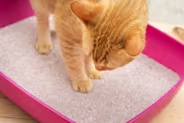
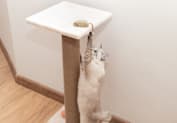
It is possible that Abby is exhibiting signs of stress in her home environment. You can do the following to help make sure Abby’s environmental needs are being met. Cats need at least one litterbox per cat plus one extra to help reduce stress associated with the litterbox, which it sounds like you already have. They should be at least 1.5 times the size of the largest cat. The boxes should be placed in separate rooms, away from the food and water bowls, must be scooped at least daily (preferably multiple times a day)and washed out at least weekly with a mild soap, followed by thorough rinsing. Cats need a lot of space to explore, but keeping them indoors is much safer than letting them outside, due to the risk of injury from cars, wildlife, other animals, etc. The key is providing space (particularly vertical space for climbing, such as cat trees, ledges, and the like) inside the home. Visit http://www.veterinarypartner.com/Content.plx?P=T&C=33&S=2 and https://indoorpet.osu.edu// for tips on stress reduction. Also look into Feliway, a synthetic pheromone that is available in a diffuser and spray form that promotes calm feelings in cats http://www.feliway.com, and Feliway Frineds, which can help cats get along with each other, in case there is conflict between the cats. https://www.feliway.com/ca_en/Products/FELIWAY-FRIENDS-Diffuser? Defecation outside the litterbox can be due to infection, constipation, difficulty getting into the litterbox due to pain, or other reasons, so if these changes don't help, I recommend you have Abby seen by your veterinarian again as soon as you can to help determine the cause of his behaviour and to start treatment.

1Pet Parents found this answer helpful
Related Answers from Veterinarians
-
Published on December 1st, 2018
You may want to try to add some feliway diffusers around the house. Feliway is a feline pheromone that can help with this type of behavior. If it continues I would talk to your vet about an anti-anxiety medicine to see if that helps as well. I hope he starts to feel better!
1Pet Parents found this answer helpful
-
Published on October 31st, 2016
A good first step anytime a cat has litter box issues is to schedule a veterinary check up. You may want to bring in a sample of Aurora's stool as well to check for common issues such as parasites. If she checks out healthy, looking to stress is the next step. Are there other cats in the house that may be blocking her from using the litter box when you are home? Are there enough boxes for each cat to use? Is the box too tall and hard to get into? Is there something that may be triggering her stress when you get home such as a young child or person that may be bothering her? Finding answers to these questions may help solve the issue. Other tools such as pheromone diffusers, adding in multiple litter boxes, or restricting house access may help with the issue as well. The following links about litter box issues in cats may also help you figure out a cause and solution: https://www.petcoach.co/article/?id=68 and https://www.petcoach.co/article/?id=51
1Pet Parents found this answer helpful
-
Published on September 19th, 2018
I recommend a veterinary exam, fecal and urinalysis. She may have a medical problem causing this. If she’s not spayed I would also have her spayed soon. That often will help this since she won’t constantly be in heat. In addition I would confine her to a small room with her food, water and litter box. Try different litters to fined which she’s uses best. After she is back to going in the box for several weeks then I would gradually let her out into a few other rooms. Most cats are clean and neat and don’t do this unless there is a medical problem. Thanks for using Petco Pet Education Center, formerly Petcoach to help you care for Mimi.
1Pet Parents found this answer helpful


long story short, moved 6 months ago and my cat has had fits ever since moving. before we moved, she good. now she won’t use the litter box, has peed on me, peed and pooped in dining room, on couch and bed. it’s been off and on since the move and i d
I have 2 cats, A large male who can sometimes be a bully and a smaller, female cat. The female cat is very skiddish. When we first got the female cat she had difficulties using the litter box. I got an additional litter box and both cats were sharing

Hello, I just adopted a cat whom I already knew tended to poop outside her box. It started after she was dewormed and never stopped. She doesn't always do this but often. She also had a very sore rectum before I adopted her. This is worse than I was
My cat always poops on the floor instead of litter box. Have tried everything to stop it. What could be wrong and what can I do?
Lately my husband and I have been going through a "seven year itch" not seeing eye to eye and definitely having relationship issues. One of my two cats, "Tess", has been displaying a less than acceptable moreso intolerable behavior. She has begun to

My cat has been pooping by my front door and still pooping in the litter box. I always keep it clean. He also peed on my bed today .

How can I stop inappropriate urination AND pooping? I’ve recently taken in a stray cat, she did have tapeworm so I thought that was the reason. She’s been cleared of it for weeks now and still will not stop pooping in our hallway and peeing on the la
I found a kitten on the streets, and took him with me until I found him a new home. He used his litter box normaly. No issues, until I took him to his new owners. After 2 days of staying at his new home, he was returned to us due to new owner's medic

My female cat will poop in the litter box but not pee, she pees whenever she feels like it. Could there be something physically wrong

Hello- I am not sure if this is a behavioral question or a health question. My female cat has started defecating outside of the litter box. This has gone on off and on for the past few years. I’ve noticed it’s gotten worse in our new house we moved t
Book an appointment with the pros – our expert vets are here to help.
