


Why is my house gecko dragging legs, constipated, and not eating?
Updated On September 23rd, 2025
My Mediterranean house gecko is not able to move his rear legs and I haven't seen feces in more than a week. He moves by dragging himself on his front legs and has been eating very little. I believe this is due to nutritional secondary hyperparathyroidism, as I have (regrettably but realistically) been failing to provide him with a lot of calcium, D3, and UV exposure. What steps can be taken to help him gain back his health and regain his ability to move his rear legs and tail? Thank you.
1 Answer
Most Helpful Answer

Published on February 11th, 2018
Most house geckos are nocturnal and do not require UVA/UVB lighting, but it won't harm them. Ideally, Dartzilla should be examined by your veterinarian or a vet experienced in treating reptiles to diagnose illness or injury. The paralysis may be compounded by constipation, especially since there has been no stool recently. Soak Dartzilla in a warm 50/50 solution of water and unflavored Pedialyte for 15-20 minutes. This will provide warmth and hydration. Both can aid in digestion and promote GI motility. A gentle abdominal massage, front to back, during the soak may stimulate defecation. Offer appropriately sized prey, no bigger than the space between his eyes. Gut load them for 24 hours prior to offering to maximize nutritional value. You can use a quality fish flake or high protein baby cereal for this. Rep-Cal Herptivite and Rep-Cal Calcium with Vitamin D3 are the gold standards for vitamin and mineral supplementation. You can find them online or in the local Petco. Follow label directions for dusting prey.

1Pet Parents found this answer helpful
My gecko has a bump on its leg and he can't move it looks like it swollen and i don't know what to do, I've been letting him stay on top of his rock and keeping the lamp on him, he won't move eat drink or poop,

What is wrong with him? He’s about 8mo this old/ has not been eating for a week or two but still passes fecal matter- I’m pretty sure he is male. I don’t remember seeing this mark before today
my gecko hasn’t pooped in about five days and i’m starting to get really worried. i just got him about two months ago. he’s been eating regularly but just not pooping. i put him in some warm water and rubbed his belly and i gave him a drop of olive o
I have a gargoyle gecko all OK last two years but very recently lost weight to point I can see his ribs, his legs and feet are weak. Has wood chip substrate Cork board walls hollow logs and branches. He eats phelsuma mix and locusts mist once day or
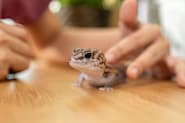
My adult female gecko Mochi Pancake hasn't been eating in the last 4 or 5 days. I usually feed her 2-3 superworms every 3 days. I wave worms in front of her but she just turns away.
Mushu stopped eating mealworms one day suddenly, and wouldn’t eat for a few days. I had dusted his food a few times with calcium without d3 for the last month but not very much. The other day I got crickets and mushu had one, I got a silkworm but wo
I have a crested gecko and he has been very lethargic lately. He's not eating, not climbing, and spending most of his time on the ground.
My lowered geck has a very thin tail. I give him crickets, mealworms and wax worms but in 4 months ago he stopped hunting in general. He won’t go for any cricket... I have to force feed him. He had a heat pad a lights warm, cold and moist hide
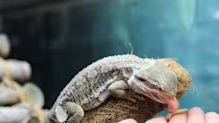
I recently rescued a leopard gecko and I have some concerns (he was my sisters gecko). 1. He is not eating and has lost some weight. 2. His legs are bowing and I'm concerned he has MBD. Is there anything I can do to help him start eating again and tr
My gecko’s legs have swollen. What can I do?

Book an appointment with the pros – our expert vets are here to help.
