Petco Text Logo
Petco Pet Logo
Jump To Section

    About Beagles


    Hound Group

    Most hounds share the common ancestral trait of being used for hunting. Some rely on exceptional scenting ability to follow trails, while others are built for endurance, capable of running quarry down over long distances. Despite these shared roots, hounds are highly diverse in appearance and behavior, and some are known for a distinctive vocalization called baying.

    Breed Appearance


    Size & Weight

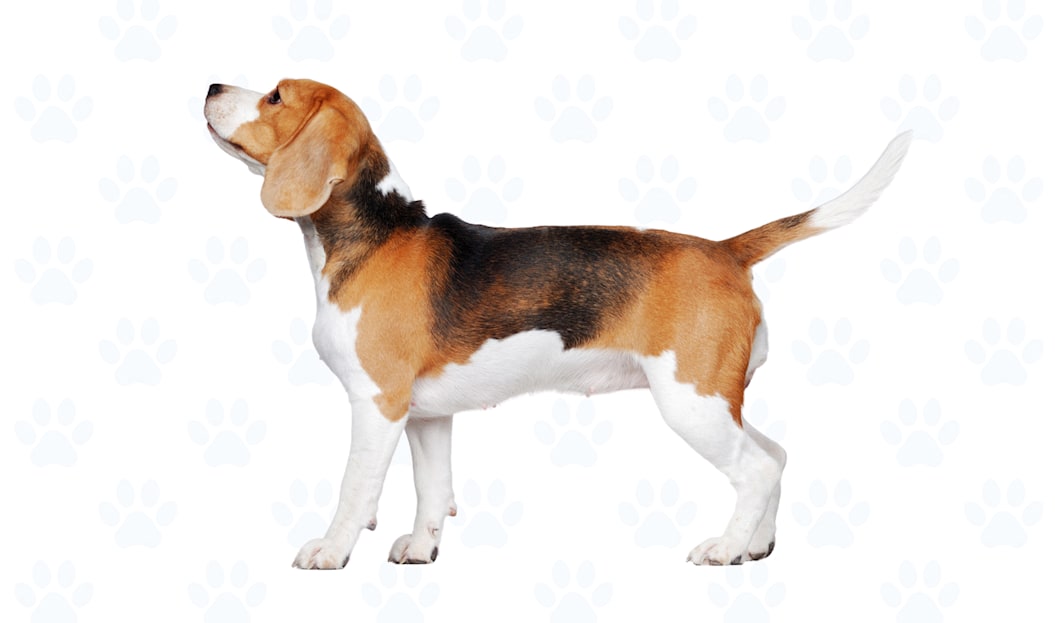
    Adult Beagles usually measure anywhere between 12 to 16 inches in height and weigh between 18 and 30 pounds.
    Full Grown
    Female
    14 in. / 25 lbs.
    Male
    16 in. / 30 lbs.
    Height bar
    Female Pet
    Height Figure
    Male Pet
    Height is measured up to the shoulders.

    Beagle Characteristics

    Size

    Tiny

    Jumbo

    Weight

    Light

    Heavy

    Shedding

    Minimal

    Abundant

    Coat Length

    Short

    Long

    Grooming Frequency

    Occasional

    Frequent

    Living Space

    City apartment

    Ranch

    Exercise

    Couch potato

    Bring it on!

    Climate

    Warm

    Cold

    Personality

    Antisocial

    Outgoing

    Protection

    None

    Bodyguard

    Behavior with Kids

    Always monitor

    Babysitter

    Training

    Headstrong

    Obedient

    Barking

    Mute

    Loud

    How to Care for a Beagle

    Caring for a Beagle means embracing a curious, friendly companion with a nose that’s always on the move. These active dogs thrive with regular exercise, scent-based enrichment, and patient, positive-reinforcement training. With a consistent routine, your Beagle’s happy personality and adventurous spirit will shine for years to come.

    Coat & Grooming: Beagles have a coarse, short coat that needs little in the way of grooming. However, they tend to need more bathing than average, after all the smelly adventures they like to pursue. Their nails need to be trimmed about once a month and their long hanging ears should be checked regularly for wax and debris that can lead to infections.

    Shedding: Beagles do shed seasonally to grow, and lose, a wintery coat. They should be brushed regularly with a bristle brush or hound glove to round up stray hairs.

    Training: Beagles are bred to follow their instincts, not commands! Because of their independence and single-mindedness, they are ranked in the lowest group of dogs regarding working or obedience intelligence. Even when Beagles are contained, they can be stubborn pupils and easily distracted. Treats are usually a good motivator, but when the food runs out so does their focus. They require firm leadership with a consistent training regime to become an obedient dog.

    The best way to get these hounds performing well is to channel their breed characteristics. Nose to the ground, tail high, ears flopping - watching a Beagle at work in the field is like watching an artist in flow. Recreational tracking, hunting, and nose work are great opportunities to see them perform. They can even hold down a professional gig. The US Customs and Border Protection’s Beagle Brigade uses Beagles to prevent pests and diseases from entering the country in illegal agricultural products. The Beagles’ success rates can be up to 90% after two years of experience and some Beagles recall nearly 50 different odors.


    Barking: The amount of noise a Beagle makes is disproportionate to its size. They’re known for being one of the most vocal dogs, barking and howling frequently. And they snore, too. Beagles have three characteristic kinds of vocalization: bark, bay, and howl. Their bark is loud and full. They bark when alarmed or when asking for attention. Beagles bay specifically when they’re on the hunt. This is a call that alerts rest of the pack to a trail they’ve scented. The bay can be heard over long distances, making them easy to find and hard for any neighbors to ignore. They also howl in bonding with a human or dog pack, out of boredom, or when accompanying the piano.

    Beagles can be taught to use ‘indoor voices’ with commands like “speak soft” and be given leeway to use their full range when asked to “speak loud”. It’s a good idea to work with Beagles on these vocalizations, in order to reward desired behavior.

    Temperament & Behavior: Beagles are known for their sociable, friendly attitude. Despite being pack oriented, they have a confidence that allows them to explore the unknown—sometimes stubbornly.

    Behavior with Kids: Beagles are reputed to be great with kids. They are a reasonable size for children to play with and thrive on the energy of family life.

    Protection: Beagles may bark in anticipation of a human or animal visitor, and can be considered adequate alarm dogs. Overall, though, they are more bark than bite.

    Life span: On average, the life expectancy of a Beagle is 12-15 years.

    Inherited Health Issues: Beagles are more prone to developing certain diseases than other dogs, although in general they tend to be healthy dogs. Just because a certain disease is more common in Beagles, that doesn’t mean that your Beagle will definitely get it. And looking for a breeder who tests breeding pairs for inherited conditions – when possible – is a great idea, in order to give your Beagle the best chance of a long, healthy life.

    Common conditions in Beagles include: pulmonic stenosis, diabetes mellitus, cushing’s disease, mast cell tumors, idiopathic epilepsy, intervertebral disk disease, glaucoma, cherry eye, retinal dysplasia and Beagle pain syndrome.

    Preventive Care: Beagles are well known for their excellent sense of smell. This is one of the traits that have endeared them to hunters and trackers through the years. However, Beagle owners should be constantly aware of this, and take steps to always secure food and garbage. Beagles can smell food items better than most dogs, and because of this they will often get into garbage cans and grocery bags and ingest whatever food they find there.

    There are a number of routine preventive care procedures that any dog owner should be aware of. Visiting your veterinarian on schedule will help detect problems before they become serious. Click here to access our complete guide to preventive care for all dogs.

    Beagles aren’t picky eaters, and owners of these dogs will often find themselves struggling to maintain a healthy weight. Feed a good quality small breed dog food according to package directions. Visit your veterinarian for routine check-ups, which will include weigh-ins. This will help you to determine your Beagles ideal weight, and adjust feeding volumes accordingly.

    Daily Consumption: Average daily consumption for an adult Beagle is 1-2 cups.

    Energy Level: Frisky, energetic breed that is always ready for action

    Exercise: Beagles are physically active dogs with a surprising amount of endurance. They don’t need to be worked to the max, but they need more exercise than often estimated for their size. Many people don’t realize how much activity they need, which contributes to the widespread problem of Beagle obesity. A recommended exercise routine includes 30-60 minutes of leash walking every day, and an invigorating cardio session, like running or chasing a ball, a few times per week. Beagles are also very social and would benefit from a nearby dog park or regular playdates.


    An amazing sense of smell is another key Beagle trait. Next to the Bloodhound and the Bassett Hound, Beagles have one of the strongest sniffers in the dog world. Most dogs follow a scent through the air, but Beagles excel at following the trail of a scent along the ground. They need to be kept on leads, because once they’ve picked up a trail, Beagles are dogs on a mission.

    Climate: Beagles have a short, thick coat that’s suitable for most climates warm or cool.

    Cost of Owning

    On average, owning a middle-aged Pomeranian costs around $800 per year
    $250
    Vet Care
    $200
    Grooming & Boarding
    $100
    Food & Treats
    $350
    Other

    Unlock exclusive rewards with Vital Care, or enjoy up to 35% off essentials when you subscribe with Repeat Delivery.

    Enjoy exclusive rewards every time you shop. Get member-only deals, points, and special offers designed to help you save more on what your pet needs.

    Never run out of the essentials. Subscribe and get your pet’s favorites delivered on schedule—with up to 35% off plus the convenience of automatic refills.

    Cross Breeds

    Select a Breed to Cross

    Choose a breed from the dropdown to see potential crosses.

    Dropdown Icon

    Your love story starts here.

    Find adoptable pets near you with a simple search.

    Fun Facts

    Beagles have 225 million scent receptors. Humans have 5 million.

    Beagles have 225 million scent receptors. Humans have 5 million.

    Snoopy, the Peanuts character, is a Beagle.

    Snoopy, the Peanuts character, is a Beagle.

    The HMS Beagle was the name of the ship on which Charles Darwin sailed when gathering inspiration for his theory of evolution.

    The HMS Beagle was the name of the ship on which Charles Darwin sailed when gathering inspiration for his theory of evolution.

    Lyndon B. Johnson owned three Beagles named “Him," “Her," and “Edgar".

    Lyndon B. Johnson owned three Beagles named “Him," “Her," and “Edgar".

    History

    Beagles are a very old breed and can be traced back as far as Ancient Greece. They have always been bred as a companionable hunting dog with a great sense of smell, and a big mouth. It’s speculated that their name comes from the Old French ‘bee gueule’, which roughly translates to ‘loudmouth’.


    As the breed developed, so did its size. Queen Elizabeth I kept small a variety called Pocket Beagles, standing about 8 inches, which no longer exist. The modern-sized breed grew up in Great Britain in the 1830s and was dispatched in packs to hunt wild hare. An American standard for the breed was developed in the 1870s and the AKC recognized the Beagle in 1885.

    Read More

    Sponsored