


Why is my dog licking, itching, and scabbing? Is it a hotspot?
Updated On September 23rd, 2025
Pet's info: Dog | Labrador Retriever | Male | neutered | 8 years and 8 months old | 87 lbs
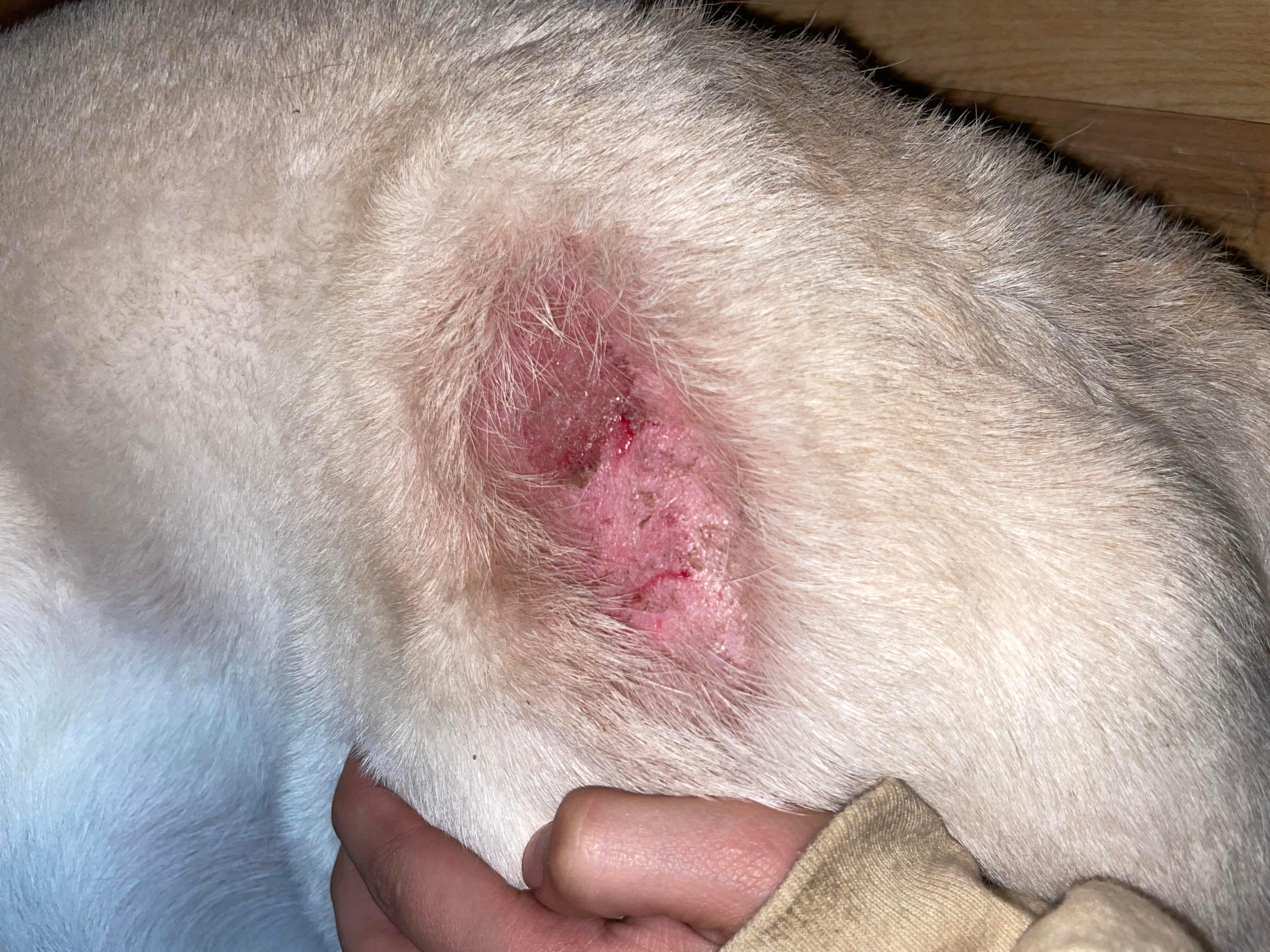
Please help I thought this was a hotspot at first because he was just licking it and I thought he just rubbed himself raw by licking it. Now it’s scabbing over after putting sulfadene on it but he’s still licking it and I don’t really know if it’s still a hotspot or not he’s itching on his body and now there’s a tinier version right above his tailbone, it looks like the same thing as the big one The little one isn’t as irritating though not raw at all. Still has fur on it not itching as much.


4 Answers
Most Helpful Answer

Published on March 3rd, 2024
Hello and thank you for using Petco Pet Education Center, formerly Petcoach. I hate to hear Cutty is having this problem! Being itchy can be quite uncomfortable for pets and is also hard on their human companions. A hot spot is an infection that often has a trigger such as fleas or allergies. They are very itchy. Cutty could be itching and scratching for many reasons. The most common reasons are •Fleas •Allergies (environmental or food) •Skin mites •Bacterial or fungal infection •Endocrine Disease Here are a few quick check points: If there has been any new treats or food within a few weeks of the itching, stop giving the new item. It could be related to the itching. If your pet have a history of itchy skin or ear infection, it could indicate an underlying condition like allergies or thyroid disease. If other pets in the household itching, it could indicate a communal cause like fleas or scabies. Here are some things you can do at home which may help with any red/irritated areas: 1. Stop any licking (since this can make it worse) - Cutty should wear an elizabethan collar at all times. - Remember that the collar must come out past his nose in order to be effective. 2. Next, wash the area once a day with either plain hand soap (like Dial) or a medicated pet shampoo. Rinse the area well and gently towel dry. -This will help to control the number of topical pathogens as well as remove oil and dead skin cells. 3. Lastly, apply a topical antibiotic twice a day to the red areas. Make sure the skin is dry before application. -Just a dab will do and rub it in well. Neosporin is fine to use. *Always wear gloves to handle skin lesions and wash hands thoroughly afterwards. Here are some tips that can improve over-all skin health and decrease itchiness: 1) Add in an omega fatty acid supplement. - Your veterinarian will carry some nice products - You can also find a good product called Welactin online. 2) Change the diet to something like Royal Canin or Nutro as they are aimed at skin health. *It will take 4-6 weeks for any diet or supplements to take full effect 3) Wash your pup in a pet oatmeal shampoo and conditioner once every 2 weeks for general health. If you use a topical flea prevention, you will need to look for a compatible shampoo. 4) If environmental allergies are suspected, a daily antihistamine can also help. - Dogs can take Benedryl or Zyrtec 5) Keep your pet current on a good flea prevention. Fleas will do nothing except cause more irritation for an already sensitive pet. I recommend to stick with oral products that last a month or longer like Simparica, Nexgard or Bravecto. Please discuss these options with your veterinarian. Have Cutty examined if- •There is severe itching/licking •If the itching/licking gets worse •If in 5 days the skin lesion is not significantly better or if it is not fully healed in 2 weeks •If in 4 weeks the licking or scratching do not start to improve Sometimes no over the counter options will work and they need a stronger medication from the veterinarian. I hope this helps and please feel free to reach out any time. Sincerely, Dr. Elizabeth

8Pet Parents found this answer helpful
Related Answers from Veterinarians
-
Published on January 2nd, 2020
Hi, and thanks for your question. This could be due to an allergy, although it could also be infection or mites. First of all, in order to rule out skin parasites, you will need to treat with a high quality flea treatment, then ask the vet to perform a skin scrape - this might reveal an infection or a mite infestation. If all of those came back negative, the next step is to treat the allergy symptomatically and try to discover the cause of the allergy. Three main type of allergies are usually affecting pets: food allergies, flea and parasite related ones and environmental type (allergens coming from trees, pollens, dust etc etc). Some medications can be given by the vet in order to repair any possible skin lesions (like steroids and antibiotics). The following products can be found online and can be tried as a first line approach: Douxo PS Calm shampoo, Essential 6 spot on by dermoscent, Krillex Krill oil chews. Hope this answer was helpful, but please do not hesitate to contact us again on the forum or by requesting a consultation if you have any more questions or to discuss it any further. If this answer was helpful please let us know, this will be used to improve our service!
1Pet Parents found this answer helpful
-
Published on May 8th, 2018
Thanks for using Petco Pet Education Center, formerly Petcoach! This is possibly due to allergies. It really comes down to figuring out what is causing her allergies so that they can be treated or the specific allergen avoided. A secondary infection is likely and also needs to be addressed. There are many things that can cause allergies though in most cases they can be broken down into 3 big categories: flea, food and environmental allergies. Allergies are usually worked up in a stepwise fashion starting with flea allergies as this is the easiest and cheapest to take care of. If not on a flea preventative, then it would be a good idea to get started on one. If already on one then it would be a good idea to change to something else (there are many new products out in the market). If not improved in 1-3 months then it is time to move on and check for food allergies by switching to a novel diet (new protein and new carbohydrate). If that does not seem to be the issue then you are left out having to check for environmental allergies which require blood and/or skin tests. Allergies can be very frustrating to deal with at first but so rewarding at the end when we are able to treat them effectively!
1Pet Parents found this answer helpful
-
Published on July 4th, 2018
Thanks for using Petco Pet Education Center, formerly Petcoach! This is possibly due to allergies. It really comes down to figuring out what is causing his allergies so that they can be treated or the specific allergen avoided. A secondary infection is likely and also needs to be addressed. There are many things that can cause allergies though in most cases they can be broken down into 3 big categories: flea, food and environmental allergies. Allergies are usually worked up in a stepwise fashion starting with flea allergies as this is the easiest and cheapest to take care of. If not on a flea preventative, then it would be a good idea to get started on one. If already on one then it would be a good idea to change to something else (there are many new products out in the market). If not improved in 1-3 months then it is time to move on and check for food allergies by switching to a novel diet (new protein and new carbohydrate). If that does not seem to be the issue then you are left out having to check for environmental allergies which require blood and/or skin tests. Allergies can be very frustrating to deal with at first but so rewarding at the end when we are able to treat them effectively!
2Pet Parents found this answer helpful



Sammie has had 3 of these type of spots in the past 3 months. She experiences hair loss, and then develops redness with a circle. We’ve taken her to the vet numerous times and they keep thinking it’s an allergy. We did an allergy test and are awaitin

My dog won't stop biting, licking, and scratching his tail, lower back, and inner thighs. He's chewed hair off of the areas that have been bothering him and sometimes to the point of making a sore. He has a history of allergies and dry skin (we saw a
My dog Shih Tzu keeps itching in one spot. He has scratched so much he skin looks red under his coat. Please Help
My dog has been itching and licking his back above his tail, not right at the base but like hips I guess. Maltese Shih Tzu, 3 yo, no new changes to diet or environment. He has this dark red spot I've just noticed. Could this be a tick? He has not bee
So thunder is shedding really bad right now, I don’t think that’s uncommon right now so I’m not worried about that but I am worried about him biting the same spot over and over, it’s red and it looks like he may have broken some skin. It’s been going
Is this a hot spot, an allergic reaction, or rash?
I noticed this past week that my puppy has been itching his armpit. It’s only one of them but is this a hot spot? What can I do to treat it?

Chico has developed a round spot on back knee that he keeps licking. All hair gone off of it and red looking. Keeps adding to the size of it because of licking. What to use on it......hydrocortisone??? May harm the dog. anything else??

Max is very itchy and biting areas of his fur. Went to vet for yearly visit a week ago and said it might be allergies. Gave max fish oil and cetirizine. Since then he developed a bump which is now bleeding due to scratching. Is this something other t

My cat was diagnosed as probably having some type of allergy bc he was licking himself raw. He got a steroid shot and it went away for about a month. He got another shot two weeks ago bc he started licking again and this time it did not work-?hes giv

Book an appointment with the pros – our expert vets are here to help.
