


My dog's leg lump is changing color and size. What should I do?
Updated On September 23rd, 2025
Pet's info: Dog | Mixed Breed Small (up to 22lb) | Female | spayed | 12 years and 4 months old | 15 lbs
We recently discovered a lump on our dogs leg. It started to shrink yesterday but today grew larger and changed from pink to purple.


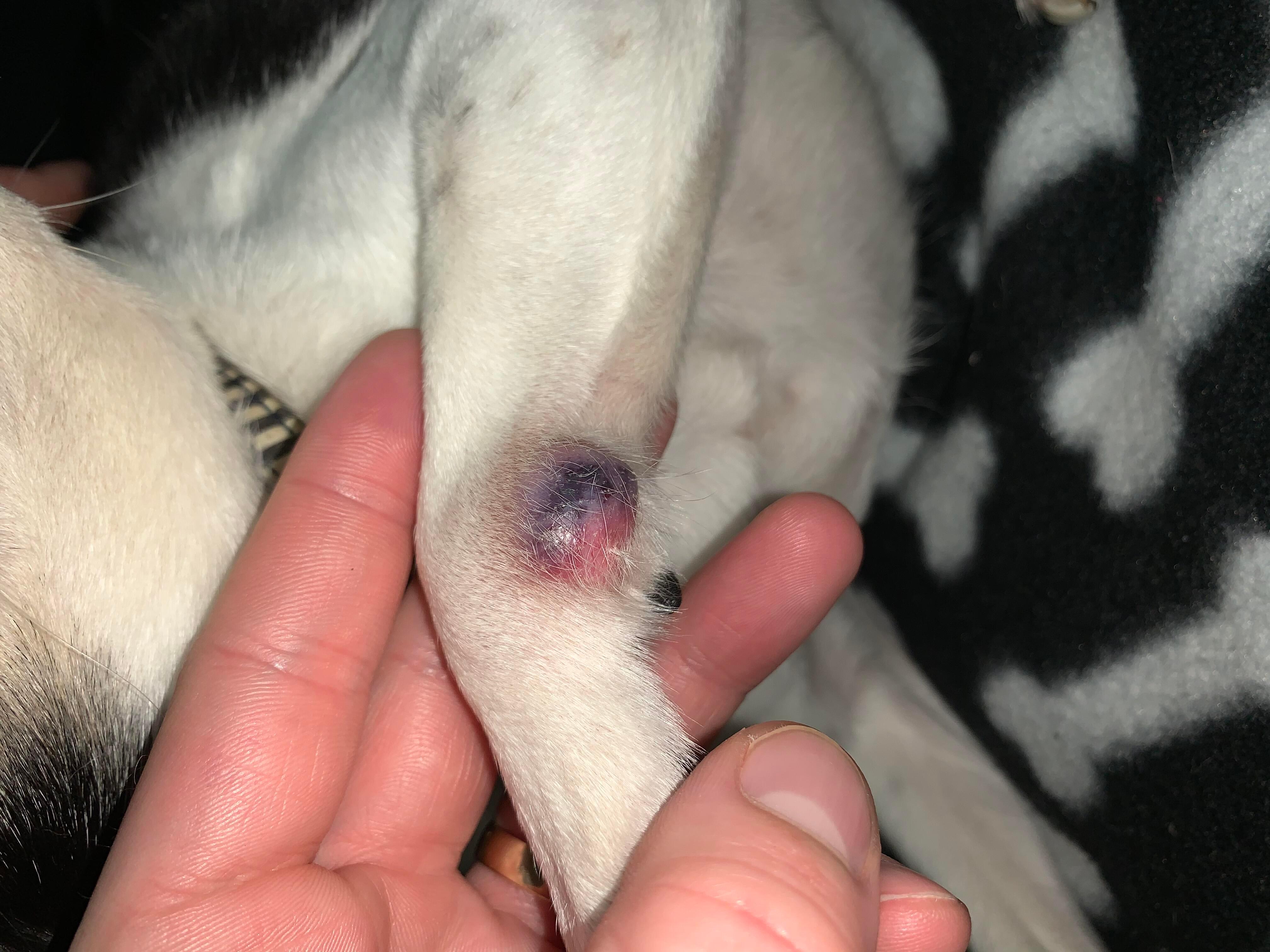
4 Answers
Most Helpful Answer

Published on May 27th, 2020
Thank you for contacting Petco Pet Education Center, formerly Petcoach with your question about Lady. This lump could be a cyst, a benign growth, or a malignant growth. Any suspicious lumps should be examined by the vet. The vet can perform a test called a fine needle aspirate on it. To do this, the vet sticks a small needle into the lump to get a sample of its cells, and examines the cells on a slide under a microscope. It's usually painless to the animal, and relatively quick to perform. Once the cause of the lump is diagnosed, the vet can discuss treatment options if needed. Give her vet a call to make her an appointment. I hope this helps!

3Pet Parents found this answer helpful
Related Answers from Veterinarians
-
Published on July 14th, 2017
Please keep in mind that without seeing the lump in person, or even a picture of it, there's no way I can say for sure what it could be. The lump on Joni could be a benign tumor, due to a foreign body such as a grass seed, a cyst, or even a malignant tumor (unfortunately always a possibility in a middle aged dog). the only way to know for sure is to have her seen by a vet. The vet can perform a test called a fine needle aspirate on it. To do this, the vet sticks a small needle into the lump to get a sample of it's cells, and examines the cells on a slide under a microscope. It's usually painless to the animal, and relatively quick to perform. I would take her into the vet on Monday to diagnose what is causing the lump so it can be treated as needed.
1Pet Parents found this answer helpful
-
Published on February 17th, 2017
I can understand being worried about Benny, but I wouldn't get freaked out. The best way for you to know if this lump on her leg is to have her seen by a vet. The vet can perform a test called a fine needle aspirate on it. To do this, the vet sticks a small needle into the lump to get a sample of it's cells, and examines the cells on a slide under a microscope. It's usually painless to the animal, and relatively quick to perform. This test may help differential between a malignant tumor or a benign one. I say "may" because some tumor types need a biopsy to diagnose them, and the vet can recommend having that done if needed. Have this lump examined and diagnosed by a vet, and then they can discuss treatment options with you.
1Pet Parents found this answer helpful
-
Published on April 29th, 2018
Thanks for using Petco Pet Education Center, formerly Petcoach! This could be a benign or malignant growth. There is no way of knowing what it is just based on its appearance. This is often differentiated by a test called a fine needle aspirate (FNA) which is a pain free, inexpensive and easy procedure which in most cases will help reach a diagnosis. Sometimes a biopsy is needed for a definitive diagnosis. I recommend that you have her evaluated by your veterinarian for further assessment and treatment. I am really hoping for something benign. Good luck and have a good night!
1Pet Parents found this answer helpful



My dog has a red lump on his leg, near his foot.
Hello, I noticed my cattle dog had this sore on her hind leg today. It doesn't seem to bother her shes not limping or showing any signs of discomfort. I can touch it and it doesn't seem to bother her
Hi I found a black lump on my dogs rear right leg about 3-4 months ago and I took her to the vet and they said it could be cancerous or it could be something as simple as a wart so they said to keep an eye on it and make sure it doesn’t change at all

My dog has a lump on her side grey round the edge pink in the middle one is now appearing on her back leg

I just found a nodule on my dogs side by her front leg appears to have came out within the past 2 days has a deep red center when i try to touch it and put pressure on it she squirms. Possible ideals?

Hi i have a english bullmasiff and ive just noticed this on her back leg, above the pad, i need to know if its urgent for vet help or not etc
Millie has a growth/lump on her outside back leg. She had nothing an hour ago: went for our usual walk followed by walk back on the beach & in the water together and then for a quick swim in the pool (she LOVES swimming in the pool, playing with the

My dog has a lump on her leg roughly the size of a marble. She is a 9 year old cocker spaniel and is very healthy otherwise.

Hi my dog has had this lump on her front right leg for about a month now and out of no were it got very big it is not solid it feels like fluids are inside but also doesn’t seem to bother her but I no it does I need answers so bad
14 year old female American Eskimo has rapidly growing mass near hind leg. It appears to be oozing a bit and smells awful. She’s sleeping more but eating/drinking well. What might it be? I don’t believe she can handle surgery.

Book an appointment with the pros – our expert vets are here to help.
