


My dog has a growth. How are pet tumors diagnosed and treated safely?
Updated On September 23rd, 2025
Pet's info: Dog | American Staffordshire Terrier | Female | spayed | 9 years old | 43 lbs
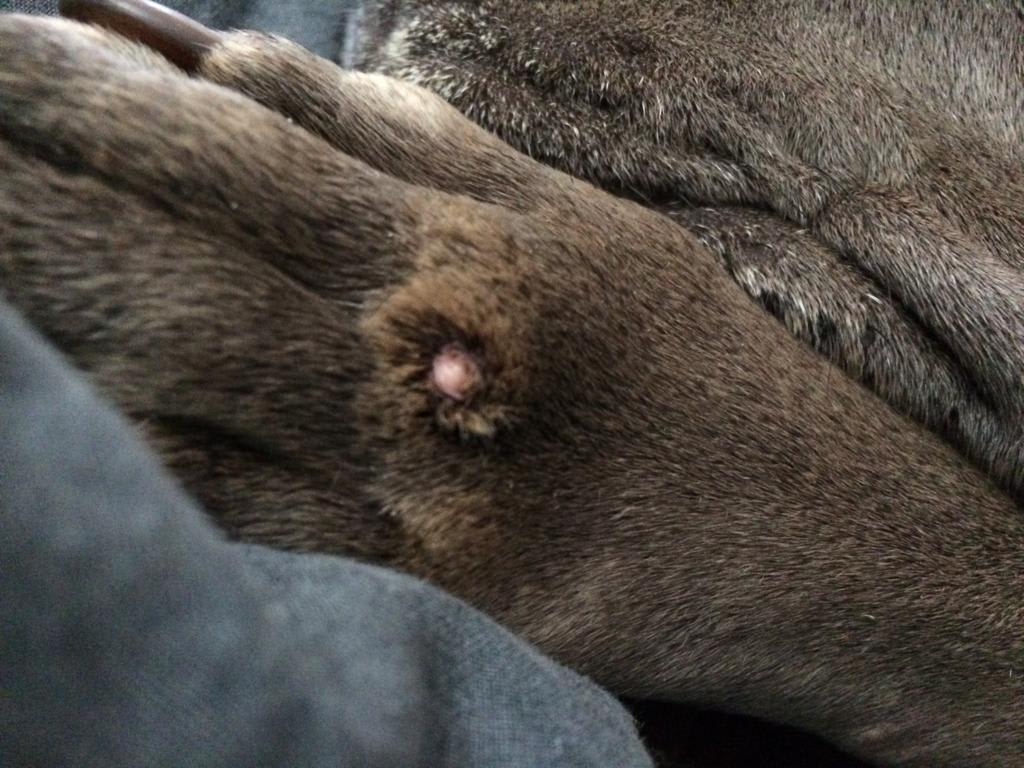
My vet said it's hard to get cells for fine needle aspiration because of the lesion's location. Is that true? The growth suddenly enlarged due to a bacterial infection- I've attached a pic of it from 2 years ago. Is it difficult to get clean margins for this growth if I opt for surgery? What kind of growth could it be? Sebaceous cyst? Mast cell tumor? Lastly, what in the blood-work indicates that Val is safe for sedation?


1 Answer
Most Helpful Answer

Published on May 1st, 2019
Very small masses can be tricky to get enough of the needle in the mass without going through it. This area of the body can be tricky to get enough margins due to the lack of tissue before you hit bone, and the movement in the joints makes closure difficult. It could be any number of soft tissue masses, including a wart, mast cell tumor, squamous cell carcinoma, etc. If your vet cannot get enough cells for diagnosis with a fine needle aspirate, simply taking a surgical biopsy without removing the entire mass is an option. When we do bloodwork prior to anesthesia, we are checking the liver and kidney values are normal, no anemia or signs of infection, adequate protein levels, etc. we just want to be aware of any issues inside the body to be able to adjust anesthetic protocols.

1Pet Parents found this answer helpful

My Malamute has a small lump on the side of his back paw, doesn't bother him at all, vet isn't sure what it is,maybe a cyst. He's been given a course of antibiotics and steroids for 2weeks, if this doesn't help vet wants to go ahead and remove lump.
Yesterday she got spayed & also a mass/bump removed. The mass is being sent off next week to be tested. But until then, what could this have been? It has never bothered her nor has she ever bothered it, it was small & only grew a little bit since Jun

ello! My 12 year old schnauzer has a growth the size of a pea on her neck. It recently started pussing and crusting over. See attached photo. I want to get it removed but I’m concerned she is too old to go under anesthesia. She has a heart murmur and
My dog has a soft bump under skin that seems to move around when you touch it. It's not painful to him. Eating and exercise normal. Someone said it could be a fat tumor. How do I get rid of it?
Would a Vet have been able to diagnose a mast cell tumor on a microscope? I don’t want it to be that. Precious got blood tested from a bump & the doctor said she nor anyone else there trained to know what kind it is. She said it was all of the same
My vet dx my 1 yr old lab mix/ Golden retriever with a possible Histiocytoma or Mast Cell Tumor based of physical exam. He is treating it as a Histiocytoma and gave Entederm. I'm supposed to return in a couple weeks for a 4 week follow up and if the
Hi, my dog had a tumor that was diagnosed as seminoma with vasicular invasion. They did an additional 3 x rays and ultrasound and found a mass btw his stomach and bladder. The doctor recommends a fine need aspirate of that mass. Does he need to have
Hi, I had noticed a rather large (10 p) sized raised lump on my 10 year old Labradoodle's right hip. As a vet what would be your next steps to examine this? Thank you very much in advance! Heidi
Golden retriever has a fatty lipoma on left rib the size of 1/2 a basketball for last 2 years...stayed close to same size...aspiration a couple no ths ago said fat cells...no cancer detected...can cancer still be in it? Can it be drained? What can I
The vet tested a tumor on my dogs inner ear and said it has mast cells in it. After removal of ear and testing to see if the cancer has spread she sent the tumor in and it came back it is a histiocytoma tumor. Was the removal of the ear necessary?

Book an appointment with the pros – our expert vets are here to help.
