


Best cat food to prevent bladder stones recurrence after surgery?
Updated On September 23rd, 2025
Pet's info: Cat | Siamese | Female | spayed | 3 years and 9 months old | 6.6 lbs
My cat was diagnosed with calcium oxalate crystals and stones in her bladder. She will undergo surgery today. What is the best food/ type of food should I feed her after the surgery to avoid having this condition again?
2 Answers
Most Helpful Answer

Published on October 5th, 2017
Hi, thanks for using Petco Pet Education Center, formerly Petcoach! I am sorry you and Sanjee are going through this. First I think it important to wait until the stone analysis is back before deciding 100% what to do diet wise. Even though she has calcium oxalate crystals doesn't mean the stone will be that exactly, though it is likely. Calcium oxalate stones are the hardest to prevent recurrence. I recommend Veterinary Prescription diets like Royal Canin SO, Hill's c/d or Purina UR. I also recommend monitoring urine pH and concentration. Calcium oxalate crystals form in more acidic (lower pH) urine. If the diet alone won't control the pH and keep it more neutral sometimes we have to add potassium citrate. I think periodic X-rays to check for recurrence are also important. There are many small white dogs that have had many cystotomies to remove calcium oxalate stones. I hope this helps and I wish Sanjee the best today for her surgery and a speedy recovery!

2Pet Parents found this answer helpful
Related Answers from Veterinarians
-
Published on September 1st, 2018
Hi, thanks for using Petco Pet Education Center, formerly Petcoach! I disagree with what you were told. There are options: 1) you can be prescribed a prescription urinary diet like Royal Canin SO or Hill's c/d which have been shown to be ABLE to dissolve bladder stones. IF they are a certain kind call struvite stones. 2) Be sure a urine was tested for a urinary tract infection and to see if there are any crystals in the urine that could help identify the stone type. Also struvite stones tend to FORM in the face of an infection. 3) you can give the diet 4-8 weeks to see if dissolve the stones before going to surgery. As long as she isn't too uncomfortable. 4) if the stones do not dissolve, I WOULD recommend the surgery to get the stones out and send some stones to the lab to identify the type. To say that they will come back with out knowing what kind they are is presumptive. Chloe will likely have to be on a prescription urinary diet and possibly other medications to manipulate her urine pH but they may not come back. Obviously no one has a crystal ball but there is a lot we can do to keep them away as best as we can. But of course nothing is 100%, but to leave those painful stones there and doing nothing seems unfair. Chloe is still a young cat and I think you have a lot of options. I hope this helps and I wish you both the best!
1Pet Parents found this answer helpful

So I took my cat to an ER, apparently he has a blockage which is why he couldn’t pee. He’s in surgery right now but I want to know what kind of food do I feed my cat after surgery so that the blockage won’t happen again.

Took biscuit to the vet today and after taking an x-ray we found out that her bladder was full and that there are stones in the bladder. The vet isn’t very optimistic as he said a surgery would only be a temporary solution and that it’s the tendency
Hi, my male cat got admitted to hospital yesterday not being able to pee. He is on a catheter now and medication ( for pain, antibiotic) this situation has been going on for about 18 hours now. How can I help him not to have this again? What must I c
What is the recommended diet for a cat with a previous lower urinary tract infection?

I am very confused. My 14 yr Bichon had 2 oxalate bladder stones pushes back into bladder and removed. Thevet at the emergency hospital recommended royal canin so to get ph to 7. It is staying at 6.5 and sometimes 6. primary vet says this is fine and
I have a 3 yo male cat who presented with almost complete blockage due to crystals. My vet said that over the counter urinary tract health dry food is okay. My question is: What is the difference between Purina Pro Plan FOCUS and Purina ONE Special C
after your cat has bladder stones removed surgically, will they definitely get stones again or are chances of stones returning low enough to make the surgery the way to go? we have tried the dry food from our vet, she won't eat it, (smells awful) tri
Is purina friskies ok to give a cat with urinary stones? Cant find urinary specific food anywhere He used to eat whiskas wet food but it gave him UTI
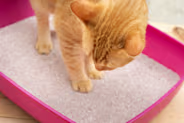
Is there any alternative to urinary food for persian cat with bladder stones? We have no access to food like that where im from. Hes 2 yrs old.

My 9 year old male dog has calcium oxylate bladder stones. He is getting ready to have his 3rd cystotomy. He is on the special Royal Canin SO food. We give him potassium twice a day. He has chronic cystitis. Are there any other options I have? I don’
Book an appointment with the pros – our expert vets are here to help.
