Petco Text Logo
Petco Pet Logo
Jump To Section

    About Whippets

    Whippets are charming, medium-sized sighthounds who are just as likely to surprise you with their lightning speed as they are to snooze all day. These are amiable and gentle dogs who are known for keeping a low-profile indoors—once they make it to adulthood. As puppies, Whippets are notoriously mischievous and will find trouble when unattended. They are independent and sometimes sensitive or bordering on shy, and need consistent, positive training to become model hounds. They can be a load of fun in recreational activities from lure coursing to flyball and agility, and like all athletes, they need to be kept warm when the temperatures dip. Their thin coats come in a variety of colors, and shed lightly, but are susceptible to nicks and scratches, which may require stitches.

    Origin: England   Other Names: English Whippet, Snap dog

    Hound Group

    Most hounds share the common ancestral trait of being used for hunting. Some use acute scenting powers to follow a trail. Others demonstrate a phenomenal gift of stamina as they relentlessly run down quarry. Some hounds share the distinct ability to produce a unique sound known as baying. You'd best sample this sound before you decide to get a hound of your own to be sure it's your cup of tea.

    Whippet Appearance

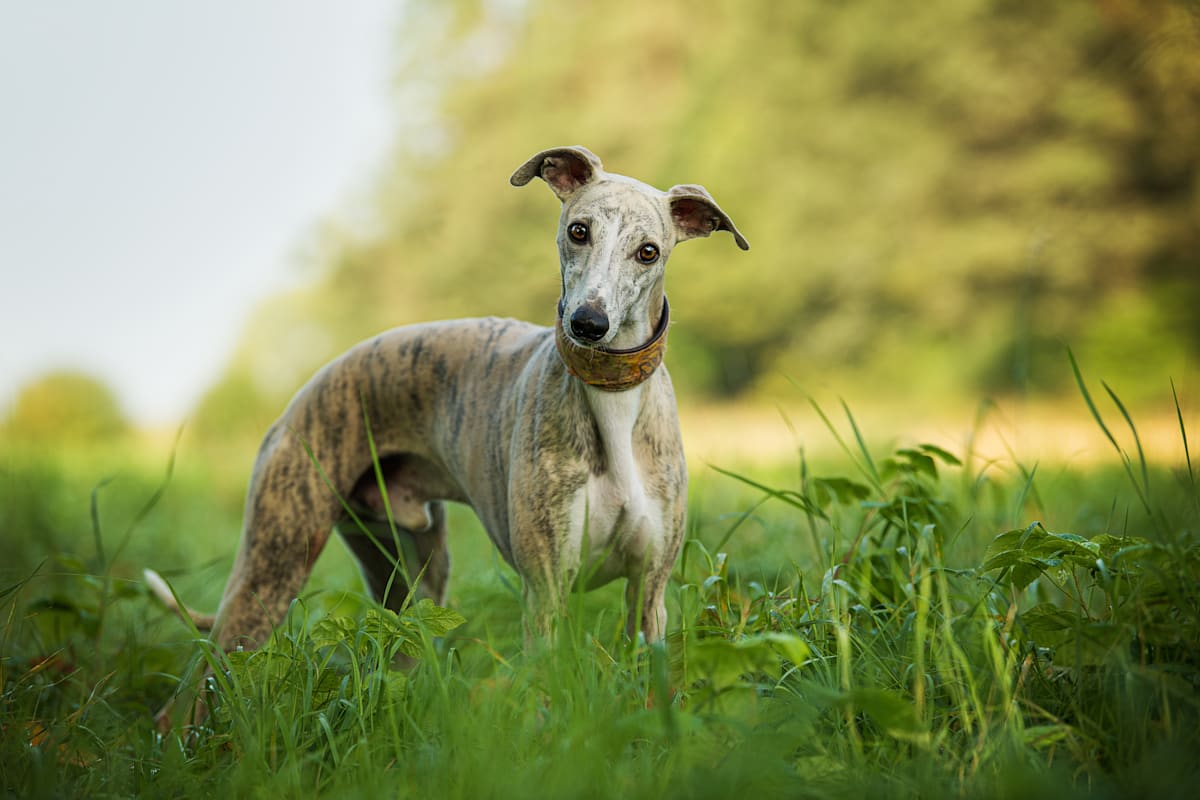
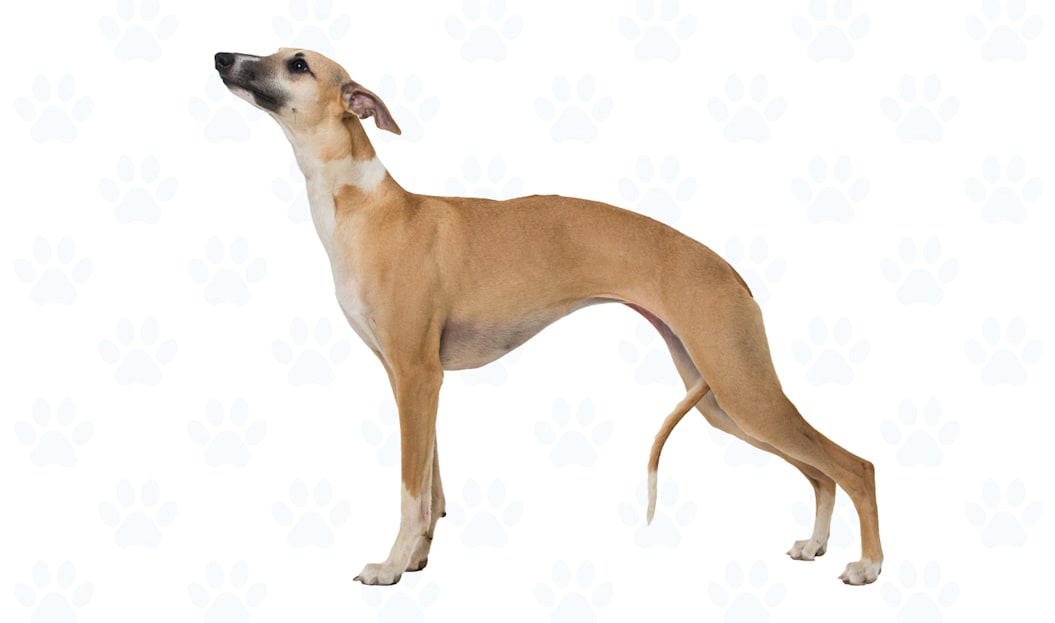
    Whippets are a medium-sized sighthound with an elegant and athletic appearance. They are slim, yet muscular, and should convey a balance between physical power, dignity, and politeness. They have long, arched necks, muscular shoulders, and deep chests. Their boning is moderate, but appears long and willowy - a byproduct of breeding for speed. They have slightly arched backs, small, pointed feet, and whiplike tails that narrow to a point.

    Whippets have a long, narrow muzzle, which widens at the skull between the ears. Their ‘rose’ ears are small and velvety, and carried back along the neck or pricked up at attention. The eyes are usually wide-set and dark, and they have an alert, gentle expression. The color of a Whippet’s coat is considered “immaterial” by the AKC, meaning this breed comes with more color combinations than a box of crayons. They can be any range from white and fawn to black, with various patterns and markings. Although the coat color can vary, the type and length of the coat cannot. There is a ‘Longhaired Whippet’ or ‘Silken Windhound’ variety, that looks identical to the shorthaired Whippet aside from the coat. This is considered to be a separate breed both in bloodline and characteristics.

    Size & Weight

    Whippets are medium sized sighthounds, standing 18-22 inches tall at the shoulders and weighing between 25-40 pounds.
    Full Grown
    Female
    18 in. / 25 lbs.
    Male
    22 in. / 40 lbs.
    Height bar
    Female Pet
    Height Figure
    Male Pet
    Height is measured up to the shoulders.

    Whippet Characteristics

    Size

    Tiny

    Jumbo

    Weight

    Light

    Heavy

    Shedding

    Minimal

    Abundant

    Grooming Frequency

    Occasional

    Frequent

    Living Space

    City apartment

    Ranch

    Exercise

    Couch potato

    Bring it on!

    Climate

    Warm

    Cold

    Personality

    Antisocial

    Outgoing

    Protection

    None

    Bodyguard

    Behavior with Kids

    Always monitor

    Babysitter

    Training

    Headstrong

    Obedient

    Barking

    Mute

    Loud

    How to Care for a Whippet

    Whippets are friendly, affectionate, and calm. They’re accepting with new people, but are prone to extreme shyness. As a precaution, Whippets should be safely and consistently exposed to new environments, noises, and people during puppyhood and throughout their lives.

    Coat & Grooming: The Whippet’s thin, short coat is easy to manage, although it may require some repairs from time to time. They can suffer a number of minor ailments because of their thin skin, like nicks, scrapes, and sunburn. Some of their skin injuries may occasionally require stitches. However, thanks to their delicate hide, Whippets don’t have a strong smell or excessive coat oils, and can be bathed less frequently than other breeds with thicker coats.

    Shedding: Whippets have a short, fine coat which sheds modestly. A good diet and regular brushing will keep shedding to a minimum.

    Training: Whippets are an independent breed, like other varieties of hounds. This means they won’t constantly look to their masters for direction or praise. It doesn’t mean that they can’t follow basic obedience, and many even learn enough to pick up on some other more complicated directives. In general, they’re willing and speedy learners. Some individuals can be prone to shyness and are especially sensitive to the touch. With all Whippets, but particularly these sensitive individuals, consistent positive methods will yield the best results.

    Any breed of dog needs a degree of training, and each breed for its own pronounced reasons. For Whippets, training should be undertaken as a matter of their own safety. Leash training will prevent them from breaking free to chase whatever catches their attention in a dangerous or busy environment, and doggie socialization will help keep them out of fights — from which Whippets usually suffer the worst of the injuries.

    Barking: Whippets are typically a quiet breed, delicately prancing through the house or apartment, and rarely barking. It’s said that Whippets don’t bark unless there’s something worth barking about. Bark-worthy things could include sudden noises, or getting ready to go out for a jog in the morning. More often, Whippets yowl, growl and howl along with, or instead of, barking. Their bark is full, and a high or mid-range pitch.

    If Whippets become regular barkers, they’re probably experiencing chronic frustration that could be caused by lack of exercise, separation anxiety, or extreme boredom. A normal, healthy routine will prevent stress barking, and keep most Whippets quietly satisfied.

    Personality: Whippets are generally quiet, friendly, and sensitive. While the breed tends to be on the shy side, a well socialized and stable Whippet should be calm and relaxed in a variety of situations.

    Temperament & Behavior: Whippets forever live a life of two dogs in one body. During their youth, they’re infamous terrors who are agile, mischievous, and destructive. However, around their second year, the same social delinquents turn out to be calm, mild-mannered, and well-behaved domestic pets who rarely make a peep. That thirst for terror and intensity then manifests itself into the Whippet’s sporadic need for speed. A few times per week, they would like to run their hearts out, while the rest of the time, they are more than content to snuggle under a blanket and sleep.

    Behavior with Kids: Whippets are playful and enjoy horsing around, however they are sensitive to touch and wouldn’t be the first choice as playmates specifically for small children.

    Protection: Whippets aren’t good choices for guard dogs. They’re usually reluctant to bark, friendly towards strangers, and don’t look particularly menacing.

    Life span: On average, Whippets live to be about 12-15 years old.

    Inherited Health Issues: Although Whippets are generally a healthy breed, several conditions have been found to occur in Whippets either due to inheritance or occurring at an increased frequency within the breed. These may include, but are limited to, the following: Pattern baldness, Truncal solar dermatitis, Ivermectin toxicosis (MDR1 mutation), Cutaneous hemangiosarcoma, Cataracts, Vitreal degeneration and Deafness.

    Preventive Care: In order to keep your Whippet in the peak of health, keep them at a healthy body weight with proper nutrition, go for regular visits to a veterinarian, and administer proper prevention against common parasites, such as fleas, ticks, heartworm, and internal parasites. Whippets are more prone to carrying a multidrug resistance gene (MDR1) than many other breeds, which can make them sensitive to certain drugs, including ivermectin and milbemycin. These two drugs are commonly found in heartworm prevention medications, but the amount of medication is small enough that problems should not arise if an MDR1 mutation is present. A Whippet’s thin coat and slight build makes them more prone to skin lacerations, so keep a close eye on your Whippet’s skin while out and about.

    Although many of the more common conditions occurring in Whippets cannot be definitively prevented, there are screening tests that are commonly performed by responsible breeders to screen breeding dogs for abnormalities with their eyes, heart, and hearing.

    Although any dog can become overweight if overfed and under-exercised, obesity is of particular concern with Whippets due to the strain it places on their slightly built frame. Be sure to carefully measure your Whippet’s meals and offer portion-controlled meals of a balanced diet. Avoid offering table scraps or too many treats, since these will quickly pack on the pounds.

    Daily Consumption: Average daily consumption for an adult Whippet is 1-1.5 cups.

    Energy Level: Frisky, energetic breed that is always ready for action

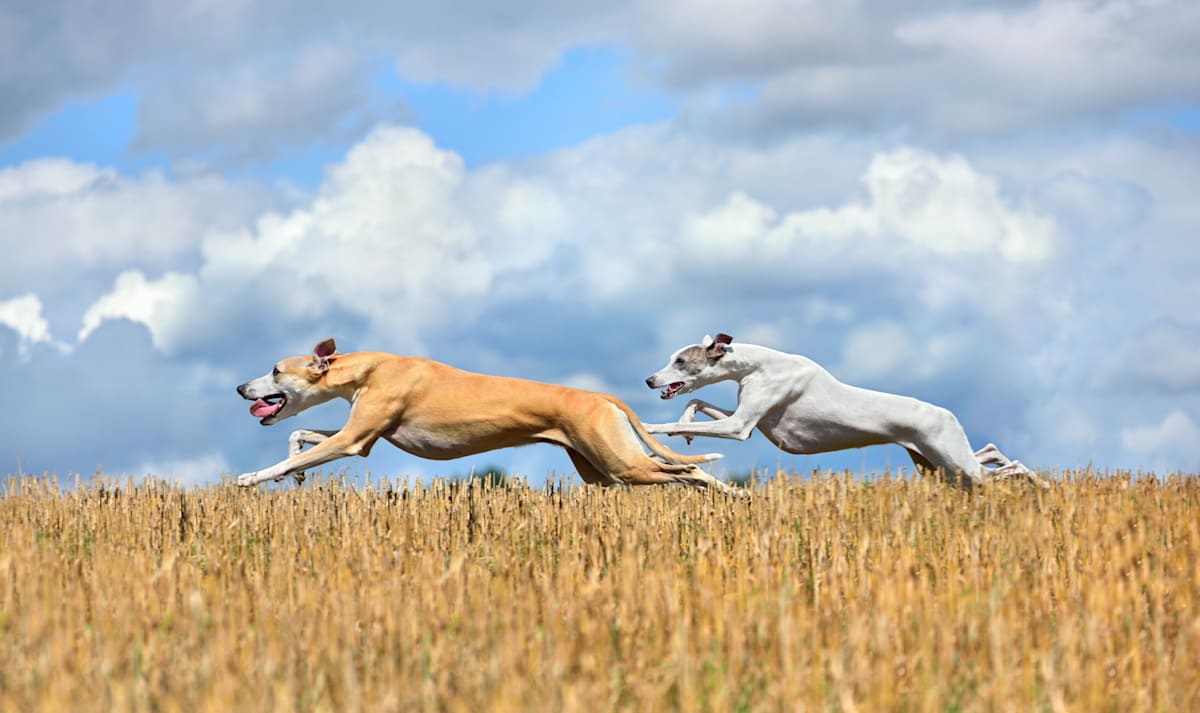
    Exercise: Overall, Whippets require only a moderate amount of regular exercise. They need an opportunity to unleash their inner speed-demons a few times per week, but can otherwise maintain good condition through regular jogging and daily walks. Although Whippets have an abundance of raw talent, they’re also willing to channel this nature into recreational activities, like doggie-sports. For example, Whippets can be great Disc Dogs or add a stunning advantage to a Flyball team. They can participate in recreational racing, and Whippets that are over- or under- size may enjoy Oval Track Racing. It’s also a joy to watch Whippets in a more original, albeit artificial pursuit: tearing around an open field during recreational lure coursing, where dogs chase a lure meant to play the part of a rabbit.
    One of the Whippets greatest charms can also be a significant downfall. With their lust for the chase, Whippets can be hard to manage around other, smaller pets, and wildlife. It’s important to raise a Whippet as a puppy with these other animals if you don’t want a chase-happy hound that leaps before it looks. For the same reason, electric fences aren’t recommended to contain this breed. Unfortunately, many Whippets are also drawn to less viable prey, like cars. Owners must take care to curb these dangerous habits early, and keep their dogs fenced or on a lead.

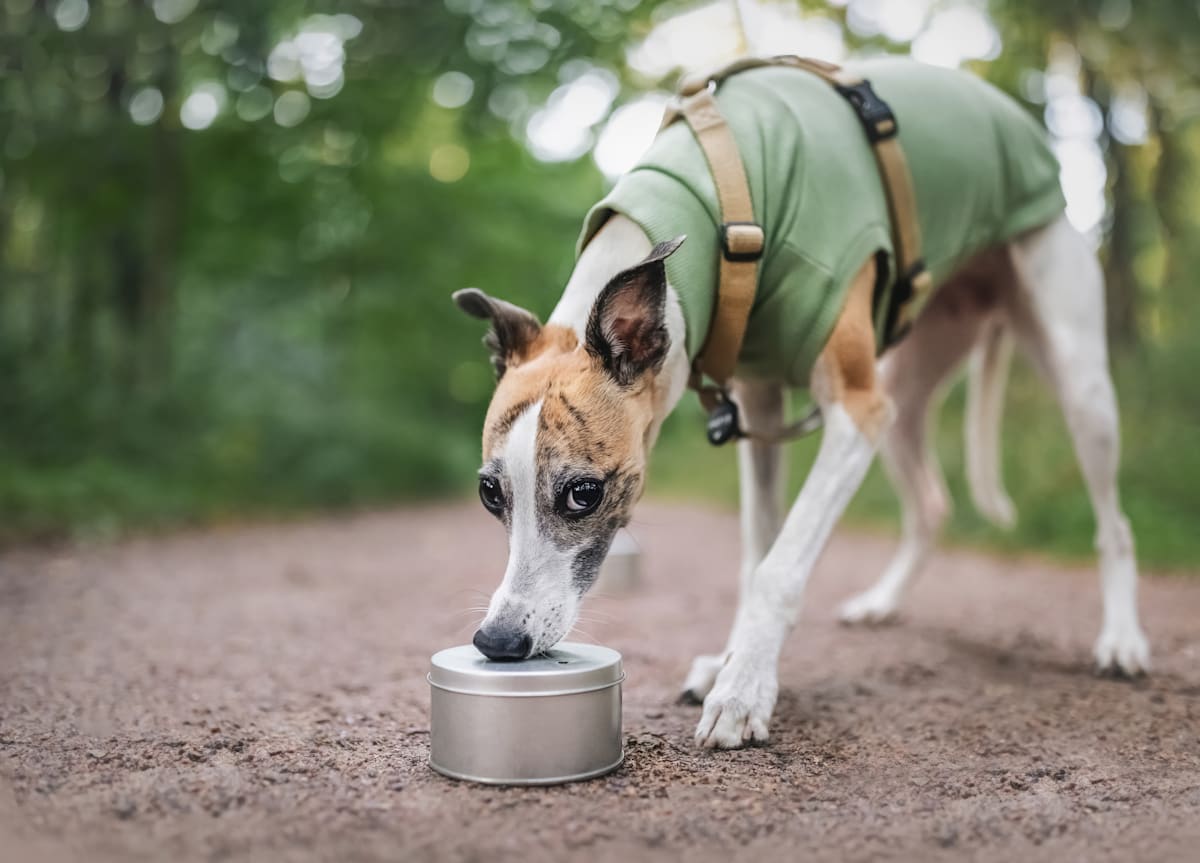
    Climate: Whippets have a short coat and thin skin, which makes them sensitive to the cold. In cold weather, they’ll need to bundle up with a doggie sweater and booties. They’re better suited to warm climates, but are susceptible to sunburn and heatstroke if they’re tearing around the dog park at top speed.

    Cost of Owning

    On average, owning a middle-aged Whippet costs around $1000 per year
    $300
    Vet Care
    $200
    Grooming & Boarding
    $300
    Food & Treats
    $200
    Other

    Unlock exclusive rewards with Petco Perks. Plus, members get 35% off their first Autoship order and 5% off all future orders.

    Enjoy exclusive rewards on expert rated and pet parent approved products, like member prices, extra points and special offers designed to help you save on what your pet needs.

    Get your pet’s essentials delivered on your schedule so you never run out and save up to 35% on your first order, then 5% on every order after that. 
     

    Your love story starts here.

    Find adoptable pets near you with a simple search.

    Cross Breeds

    Select a Breed to Cross

    Choose a breed from the dropdown to see potential crosses.

    Dropdown Icon

    Fun Facts

    Whippets are the most popular sighthound.

    Whippets are the most popular sighthound.

    Whippets may not be the very fastest breed, but they are the quickest to reach top speed.

    Whippets may not be the very fastest breed, but they are the quickest to reach top speed.

    Whippets have more coat color variations than any other breed.

    Whippets have more coat color variations than any other breed.

    Some Whippets have a genetic mutation that boosts their athletic performance. A single copy of the mutation will produce an especially speedy dog, while Whippets with with two copies will have exceedingly large musculature, and are referred to as "bully whippets".

    Some Whippets have a genetic mutation that boosts their athletic performance. A single copy of the mutation will produce an especially speedy dog, while Whippets with with two copies will have exceedingly large musculature, and are referred to as "bully whippets".

    History

    Whippets follow in the steps of an ancient breed classification—sighthounds. Sighthounds have been bred for at least five thousand years to pursue fleet-footed game ranging from rabbits to deer and even wolves. The Whippet itself is a direct descendant of the Greyhound, produced by working-class people of northern England. Whippets were first mentioned by name in 1610, and later referred to as the ‘poor man’s racehorse’ because they were affordable to house, and their owners could race them against one another for sport. Aside from racing, these speedy sighthounds could also snatch a hare for supper. The Whippet that we see today has been bred to look even more like a miniature Greyhound, and enjoys popularity as a companion well outside of England.
    Read More

    Sponsored