Working Group
Dogs of the Working Group were bred to perform such jobs as guarding property, pulling sleds and performing water rescues.
Boxers are charismatic, goofy, devoted, intelligent, and energetic companion dogs. They’re the 10th most registered breed in America. When working, they can be counted on for their alertness, self-assurance, and fearlessness. They are a medium-sized breed with a need for substantial amounts of exercise and mental engagement. As a short-muzzled breed, they are at risk for overheating–both during activity and in extreme heat. Unfortunately, they are also the breed most at risk for developing cancer. During any given day with a Boxer, it will dole out affection to every member of the family, young and old, and demand just as much attention in return.
Origin: Germany, late 19th c. Other Names: None
Dogs of the Working Group were bred to perform such jobs as guarding property, pulling sleds and performing water rescues.
Working Group dogs have been invaluable assets to man throughout the ages. The Doberman Pinscher, Siberian Husky and Great Dane are included in this Group, to name just a few. Quick to learn, these intelligent, capable animals make solid companions. Their considerable dimensions and strength alone, however, make many working dogs unsuitable as pets for average families. And again, by virtue of their size alone, these dogs must be properly trained.
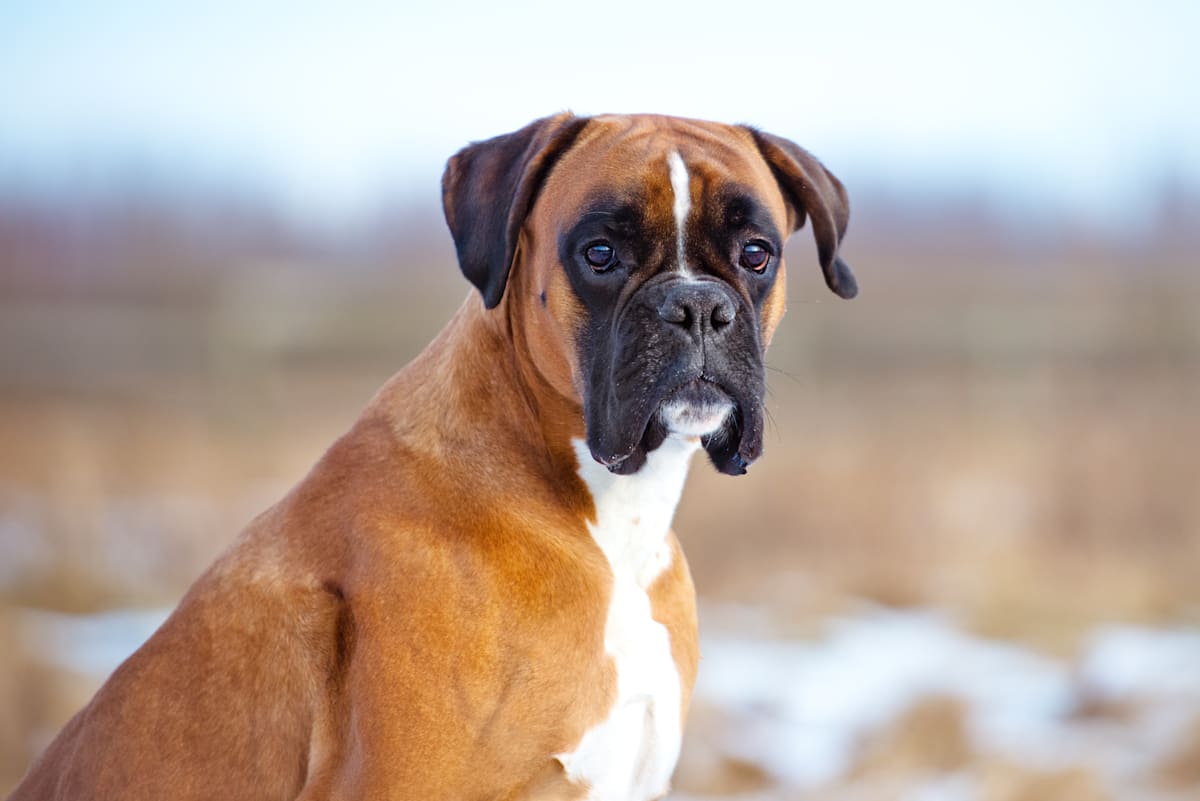
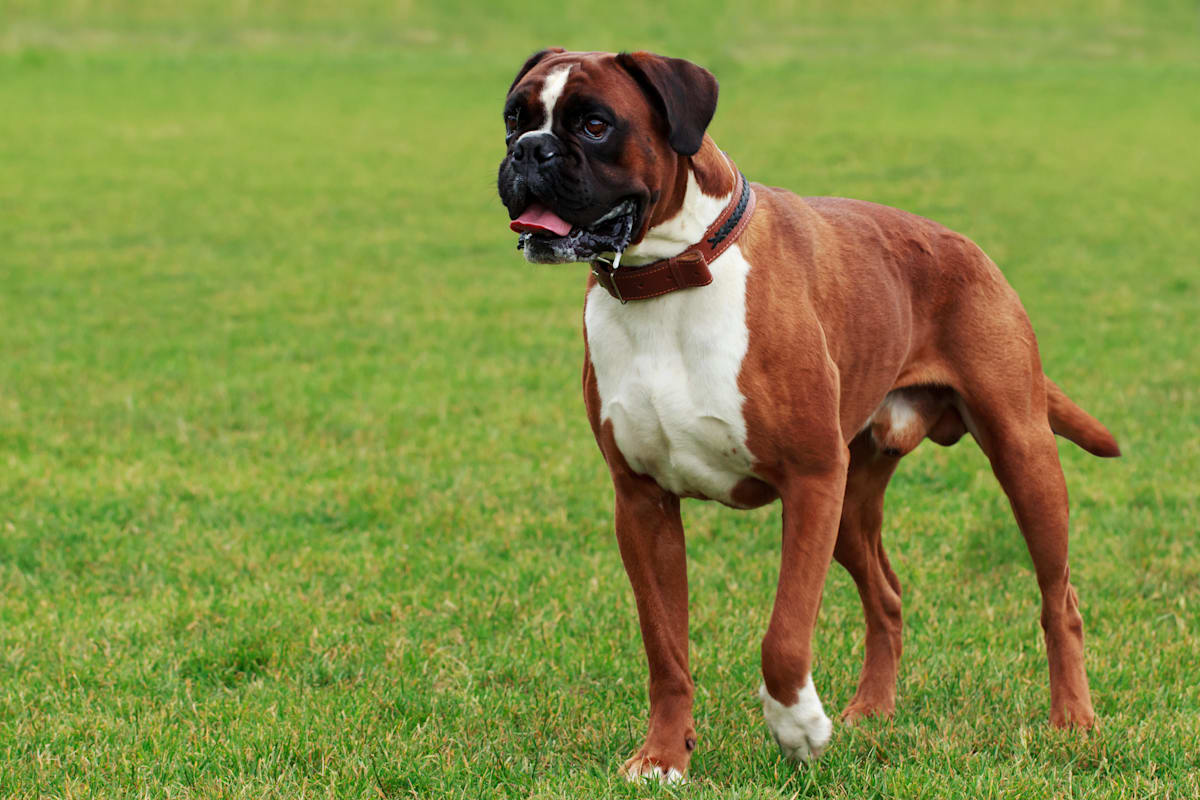
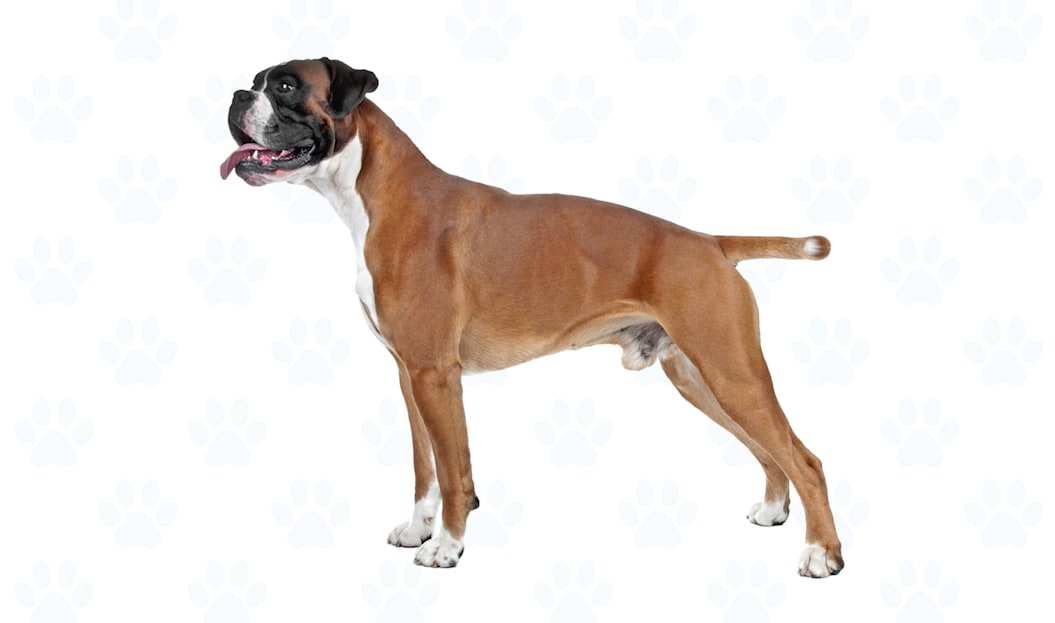
Boxers are powerful, squarely built, well muscled, dogs. They should have a proud carriage that conveys a combination of confidence, agility, and elegance. One of the Boxer’s key features is its blocky, short-muzzled head. The correct muzzle proportion is one third the length and two thirds the width of the head. They also have an underbite and strong jaws; these allowed their ancestors to hold onto game, no matter how large or ferocious.
Boxers have dark, wide-set eyes that do not protrude, and slightly wrinkled foreheads. Their ears are set high on the skull, and have been customarily cropped in the past to stand in tall triangles. If the ears are uncropped, they’re thin and medium length, lying close to the head when relaxed and creasing forward when interested. Their overall look should be expressive and alert.
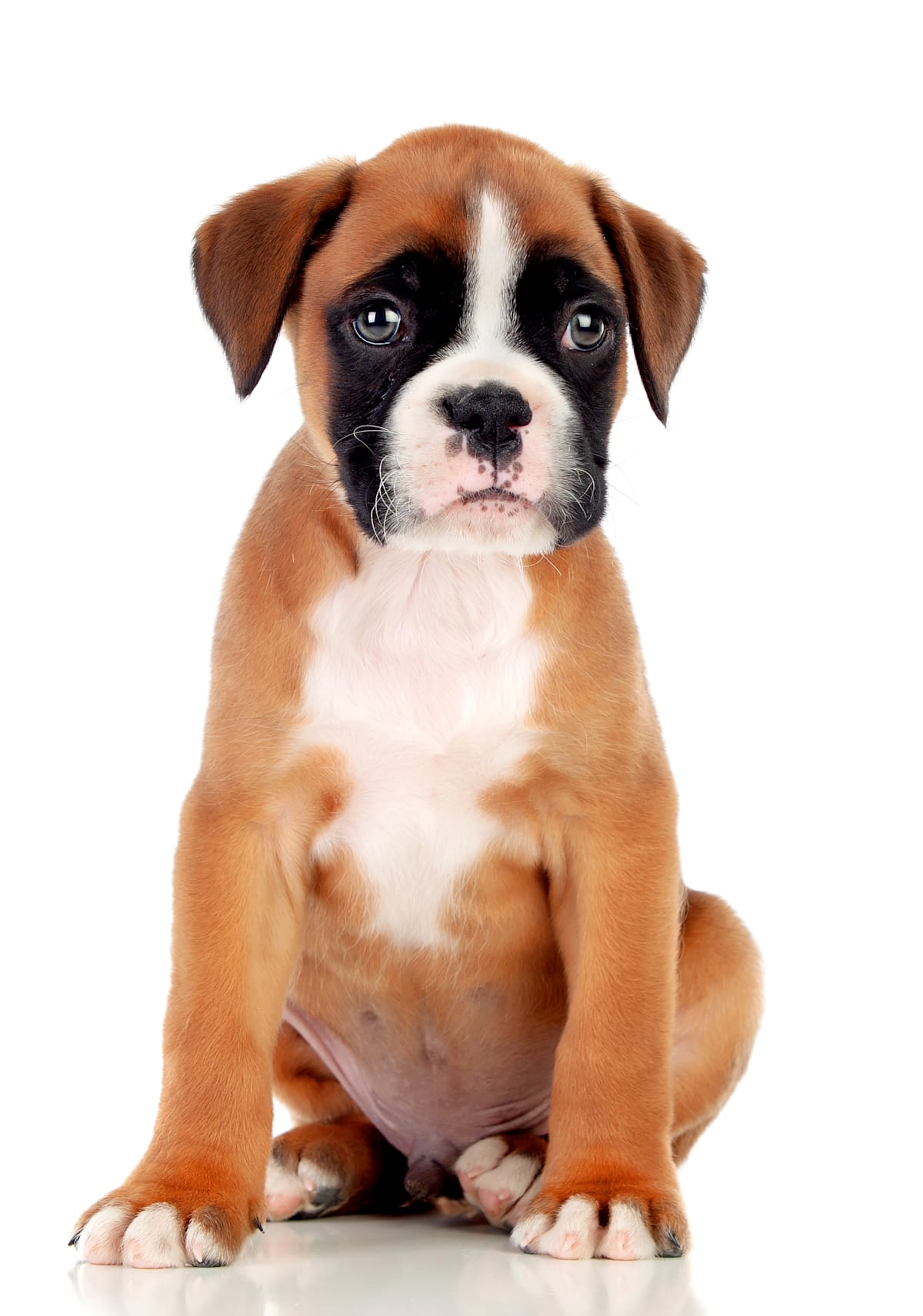
Boxers have an elegantly arched, well-muscled neck. Their backs are short and slightly sloping when standing, which levels out when in motion. They have a tucked stomach, with long, slightly angled thighs. The tail sits high on the rump and is usually docked shortly after birth. Boxers come have a short, shiny, tight coat in either brindle or fawn. They often have white markings on the feet and chest, a black mask on the face, and a white blaze from the muzzle stretching up between the eyes. While white boxers are fairly common, the color is disallowed in the show ring, and about 18% of white boxers are deaf.
Males typically stand 22.5 to 25 inches tall and weigh about 70 pounds. Females are slightly smaller: they normally stand 21 to 23.5 inches and weigh about 60 pounds.
| Full Grown | |
|---|---|
| Female | 23 in. / 60 lbs. |
| Male | 24 in. / 70 lbs. |
Height is measured up to the shoulders.
Some Boxers can grow to be quite large, but the breed is usually medium-sized, standing 21-25 inches tall and weighing up to 75 lbs.
Boxers have boundless energy and love to goof around. They would be best suited to a place where they can express their energy and not rely solely on trips to the dog park.
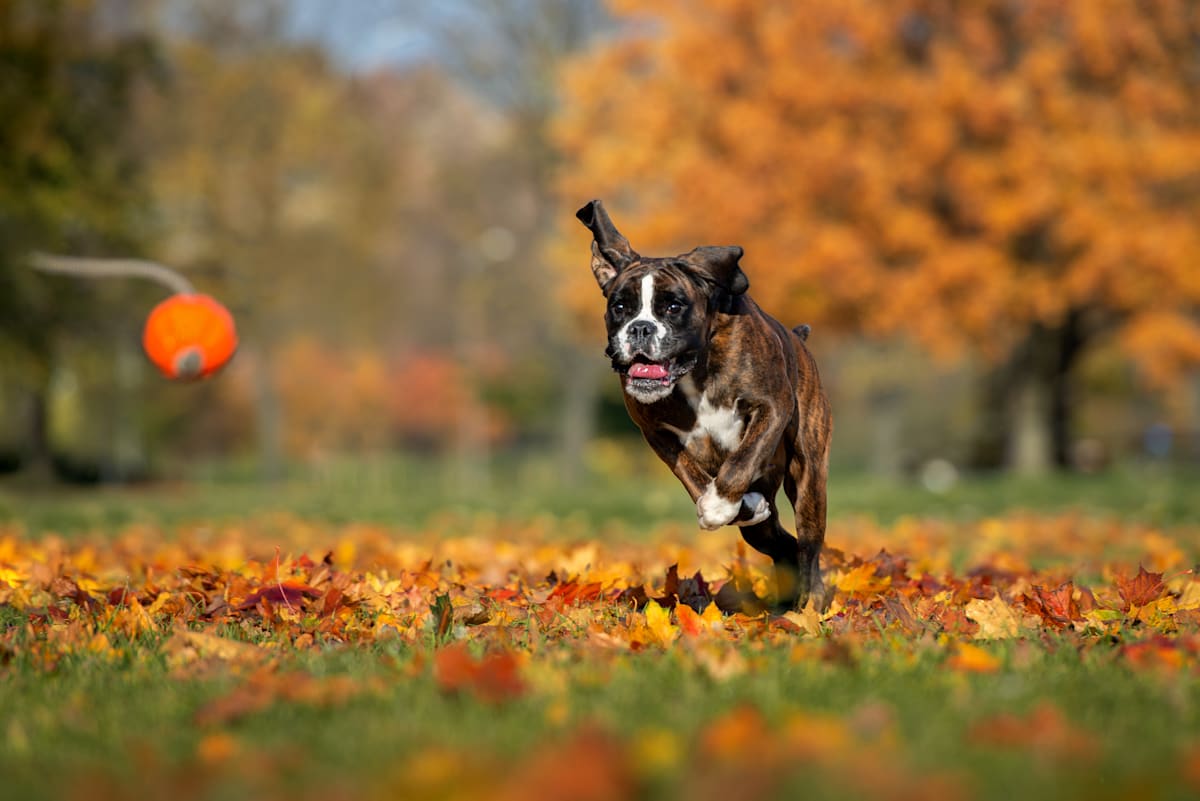
Boxers are one of the most energetic breeds around. Their basic exercise needs must be engaged daily, and extracurricular exercise will only contribute to a happier companion.
Boxers are curious, playful, devoted, and affectionate. They are known to be sunny and goofy when off duty, yet focused and alert when required.
Boxers are renowned babysitters. While they may love children, they need to be monitored in case of overrunning small children with their size and enthusiasm.
Boxers are a popular choice as protective companions. They do not tend toward aggression, however they have an imposing appearance, are very alert, and can be defensive of family or property.

Boxers are ranked as having average trainability, yet they can be seen performing tasks alongside the most intelligent breeds. They tend to have a stubborn streak, so put training objectives in their terms to avoid a battle of wills.
Boxers aren’t big barkers. Instead, they’re known as one of the “talking” breeds that makes other vocalizations to communicate.
Boxers have a short, fine coat but they do shed moderately. Their shedding shouldn’t be anything that regular brushing and good diet can’t manage.


Boxers have a very short coat which makes them sensitive to the cold and short muzzles that make them sensitive to heat, therefore a moderate climate is ideal for this breed.
Choose a breed from the dropdown to see potential crosses.
Boxers are energetic, devoted, agreeable, and remain enthusiastic and puppy-like their whole lives. They are naturally curious and playful - traits which require engaged by the poet parent. Boxers can be big clowns and demand adoration from their loving fans. They’re known to be great with children, though pawing, and their combination of power and energy, should be watched around toddlers and babies. Well-socialized Boxers are accommodating of strangers and tolerant of new situations and people.
The Boxer breed was developed to work and stand guard, though these abilities stem not from an aggressive or possessive streak, but from their alertness, agility, and willingness to defend the home. They are slightly prone to dog aggression, especially towards the same sex, and need firm guidance when learning how to greet and get along with other dogs.
Boxers aren’t frequent barkers, because real guard dogs aren’t supposed to cry wolf! When suspicious, they have a raspy, sharp bark that sounds like a classic defender of the home. They also have a high-pitched yip when they’re excited. Like all dogs, they can become barkers out of boredom or desperation. While a Boxer in a good home probably won’t be barking much, they are known to make vocal conversation. Boxers are one of the breed that “talks” by making whining, yawning, growly and yowling sounds.
Boxers absolutely need firm expectations and training. Because of their strength and boundless energy, they can become a social menace if not properly managed. Fortunately, Boxers are up for just about any task that will challenge them. They are capable learners with a drive to perform and please. On the flip side, they can also be independent-minded and mischievous, which makes consistency and starting early a key strategy for managing this breed. When trained properly, Boxers can make great service dogs, and often serve as patrol dogs in police work.
For the average Boxer, expectations need to be set about jumping. True to their name, Boxers use their front paws a lot, which can injure someone who wasn’t planning to become a sparring partner! They also need solid leash training to keep their curiosity and power in check. Sometimes Boxers puppies can be tough to housetrain. A consistent schedule for feeding and walking will be the best approach.
It’s been said that “A good Boxer is a tired one.” Boxers are a high-energy working dog that needs plenty of mental and physical challenges. If one is destroying the house, gaining weight, or constantly in your face, chances are that it isn’t getting enough exercise. Brisk, long, daily walks will provide the disciplined exercise that this breed requires, while occasional bouts of more demanding activity will help them burn off steam. Swimming is also a great way to exercise a Boxer, but they need some supervised introduction to the water as they’re not great at staying afloat.
Besides how much Boxers get exercised, timing for their activity is also important. Because of their short muzzles they’re prone to overheating, so there needs to be water on hand during long, or hot sessions. They also shouldn’t get over stimulated in extreme heat, or spend too much time outside when it’s cold due to their thin coats. Additionally, they shouldn’t exercise right after eating because Boxers are prone to bloating, which can be deadly.
Frisky, energetic breed that is always ready for action
To discourage the type of eating that may increase the risk of GDV, feed your Boxer a partially moistened diet, which slows consumption and subsequently the intake of excessive amounts of air. An air-filled stomach is heavy, and may flip over easier. Also, prevent your Boxer from running for at least 30 minutes after eating.
Average daily consumption for an adult Boxer is 2-3 cups
As a breed, Boxers are prone to several serious conditions. They are predisposed to several types of cancer, and because of this a good practice for any Boxer owner to develop is regimented, routine “patting down” of all body parts, looking for any unusual lumps and bumps. If you find lumps on your dog, make an appointment to get them checked right away by your veterinarian. Not all lumps represent cancer, but finding cancers early can increase your dog’s chances of having a complete recovery after removal.
Being overweight or obese can complicate a number of health problems. Because Boxers are predisposed to several serious heart conditions, make sure that your Boxer stays at a good weight – your veterinarian can help you determine what this means for your individual dog – so that there’s no additional stress on his heart. In addition, obesity can compound breathing problems in short-nosed breeds like Boxers – another reason to keep yours trim.
Deep-chested dogs like Boxers can suffer from a life threatening condition known as gastric dilatation and volvulus, or GDV. When GDV occurs, the stomach flips completely over, blocking the entrance and exit and occluding many large and important vessels. Without immediate emergency care, these dogs will die. Because GDV occurs relatively frequently in this breed, Boxer owners should consider a prophylactic procedure called a gastropexy at the time of sterilization surgery. This procedure prevents the stomach from flipping over under most circumstances.
Every dog deserves high quality, consistent preventive care to ensure that he lives a long and happy life. Click here to understand exactly what is recommended for keeping your dog healthy, from puppyhood to senior living!
Boxers are wonderful dogs, but like all purebreds, there are certain health problems that are recognized to be more prevalent in the breed. Reputable breeders will do any testing possible to ensure that their breeding pairs don’t pass on undesirable traits, however it’s important to understand that tests for every condition don’t exist.
Some of the most common health conditions in Boxers are: aortic stenosis, Boxer cardiomyopathy, atrial septal defect, dilated cardiomyopathy, pulmonic stenosis, sick sinus syndrome, allergies, seasonal flank alopecia, canine acne, cancer, certain drug sensitivities, hypothyroidism, perineal hernia, indolent corneal ulcers, cryptorchidism, and brachycephalic upper airway syndrome.
On average, Boxers live to be about 10-12 years old
The Boxer’s short coat is fairly easy to manage. It requires weekly brushing with a bristle brush or hard rubber grooming mitt to help round up loose hairs. They have a beautiful, sleek coat that can be polished with a chamois cloth every now and then to restore its natural shine. Besides the coat, special attention should be paid to the Boxer’s forehead wrinkles, which should be kept clean. It’s a good idea to keep those nails trimmed, too, as boxers can be quite paw-y.
Short
Weekly brushing
Boxers do shed a moderate amount, but at least the hairs are short and fine! They don’t have a double coat, either, so the amount of shedding will remain consistent year-round. As long as they have some grooming routine in place, shedding should be manageable.
Boxers were created in Germany, from an indigenous breed called the Bullenbeisser. These mastiff-like dogs were hunting companions that helped to bring down large game like bear, deer, and wild boar. During the late 19th century, Old English Bulldogs were introduced into the breeding pool, which produced the modern Boxer. Origins of the breed’s name are unclear, however ‘boxl’ in regions where the breed became popular, is the word for tight, leather shorts. This is what the smaller Bullenbeisser variant were referred to as, and the name may have just stuck. In 1904 the Boxer was recognized by the American Kennel Club. After discovering the breed during World War II, soldiers took Boxers back to their homes around the world, where the Boxer gained a reputation as the companionable breed it is today.