My betta fish has dropsy symptoms: bloated, scales out. What to do?
Updated On September 23rd, 2025
Pet's info: Fish | Betta | Male | unneutered
Hi Doctor, my betta fish is showing symptoms of dropsy. He is not having food for the last 2 days, stomach bloated, sinking to the bottom and scales protruding like thorn. Please help with the treatment methods
3 Answers
Most Helpful Answer

Published on March 20th, 2020
Thanks for reaching out about Clara. First, test and correct water quality as this is a common factor in illness. Dropsy is a clinical sign of fluid or a mass in the abdomen. The cause needs to be determined prior to effective treatment. Adding non-iodized salt to the tank could slow down the water gradient into the body but is not a treatment. For a diagnosis, a veterinary visit is recommended. Good luck.

1Pet Parents found this answer helpful
Related Answers from Veterinarians
-
Published on March 17th, 2020
Check water temperature first. Low temps can affect activity and appetite in fish. Bettas are tropical fish and do best between 78 F and 80 F. Next, confirm stable water chemistry. Use a home test kit or submit a water sample for testing. Aim for an absence ( 0 ppm) of ammonia and nitrites, with nitrates at 20 ppm or less. The local Petco may test water for free or for a small fee. Perform partial water changes to stabilize chemistry and/or to improve water quality. Use only conditioned water that is temperature matched to prevent further stress or shock. By the images, it does not appear to be ich. If it is, it is early on in the infection. Dropsy is characterized by swelling, lethargy and a loss of appetite. A classic sign is a pinecone appearance. If you see this symptom, chances for recovery are very slim. Offer live or frozen blood worms to stimulate the appetite. She should only need 1 or 2 at each feeding. An antibiotic that is effective against gram negative bacteria can be used to treat dropsy (which isn't a disease but a symptom of greater illness). You can find amoxicillin or kanamycin for fish in the Aquarium section of the local Petco. Follow label directions carefully and remove the carbon filter insert during treatment if indicated. Another possible cause may be constipation. You can try fasting her for 3 days then feeding bits of cooked and shelled green peas. This may alleviate any constipation.
1Pet Parents found this answer helpful
-
Published on August 31st, 2017
Your fish is definitely a male Betta. The finnage and vibrant color give it away. His condition has several potential causes ranging from bloated/constipation or swim bladder disease (treatable) to tumor (possibly treatable) to dropsy (usually fatal). It he isn't defecating or has trouble swimming upright, it may be the first two problems, a mass would need to be diagnosed by a veterinarian experienced in treating aquatic pets, dropsy is a serious concern. If your dishes scaled are protruding giving him the appear of a pinecone, he may have dropsy. Dropsy is a severe bacterial infection that affected the kidneys and other organs causing fluid retention and swelling. Many of these conditions are caused by poor water quality or over feeding. Test your water first then correct any imbalances via partial water change using aged or conditioned water. Rinse the filter media and confirm adequate filtration. Check water temperature. Bettas do best between 78 F and 80 F. Cold temps can lead to stress and illness. Fast him for 2-3 days then offer bits of cooked, shelled green peas until he is defecating normally. Switch to a quality pelleted diet afterwards and skip a feeding once a week. If this does not help, he may have a mass or infection. You can use an antibiotic such as kanamycin or Maracyn 2 to treat infection. These you can purchase in the aquarium section of most pet stores. Follow label directions carefully. help with swelling, dissolve a half teaspoon of aquarium salt (NOT table salt) into the tank. Adequate water quality is key to recovery, if filtration is unavailable, daily 25% water changes should be done. Again, use only aged or conditioned water that is temperature matched to prevent further stress or shock. An airstone can be used to increase oxygenation.
1Pet Parents found this answer helpful


I don’t know what to do. I think my betta is sick with dropsy. I have added a tap salt and been using bettafix weekly. Today I used mycelen omega. Can I save him. He seemed bloated last Monday.

My fish had to be kept in poor water quality for some time due to inevitable conditions. Today when we took her out in a bucket she had a fat belly. I don't know whether it can be called swollen or not but she is fat when you look from the top and ha

Hello I have a koi Betta fish and when I got it it use to eat all the time. Now it has stop eating for a week almost. It is bloated and hides in her house most of the time. I can't tell if its dropsy or ick or something else. I did treat it with salt
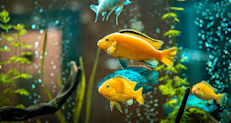
Hello I have a blackmoor goldfish that was showing signs of being bloated. He was floating at the top of the tank on his side and now has sunk. He has slow breathing and his scales are lifted a little bit but I'm not sure whether it's because of his
How do I help my beta fish? He had red swollen eyes, raised scales, wont eat, trouble breathing, and won't really swim. I don't know how to help him. I changed his water and putt him in a smaller bowl for when he's sick but this is the first time.

I bought my fish at Petco last week. The day after I got her, I noticed a swelling on her stomach. I’ve done research and found that most pictures point to dropsy. I’m in college and need the cheapest course of action to help her.
My crowntail beta as said was mail on it's container looks really fat and my other beta gets the same types of food at the same The what's the problem

My beta fish has a swollen stomach and had turned white, can you help please
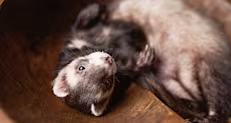
My fish died recently he had a swollen belly and his gills looked weird I am unsure if it is dropsy, can you help so this will not spread around my tank.
My fish is bulging is appearance and I am fairly sure is a female, the tank water is getting too cold for them though but I am working on that as fast as I can. I am worried she has dropsy or has eggs, what is going on?

Book an appointment with the pros – our expert vets are here to help.
