


How do I potty train my new puppy & what causes red spots on her?
Updated On September 23rd, 2025
Pet's info: Dog | Mixed Breed Small (up to 22lb) | Female | 2 months and 21 days old
Good morning. I had a question. I recently just got a Maltipoo puppy and she is 10 weeks old. I have never had a dog before so I really don’t know how to potty train her. She does her business anywhere in the house and she occasionally pees on the pads. I wanted to know how can I fix this? I had another question. I noticed that she had a red spot under her eye where the browning is the other day and it eventually went away. What could’ve caused this? Her right paw is red as well.
2 Answers
Most Helpful Answer

Published on August 5th, 2018
Hello, congratualtions on your new pup. Her red paw and red eye could have been something simple such as irritation from the environment or early allergies. As long as it is going away then you shouldn't need to worry about it and just continue to keep an eye on her. Monitor her for any worsening redness, loss of appetite, lethargy, and vomiting. If you note any of these, then have her seen. Here is some further information on how to potty train your pup. Hope this helps and best of luck. Basic Principles of Canine Elimination Behavior: • Puppies and dogs are taught by their mothers not to soil their “dens”, and have an innate aversion to doing so. • A puppy lacks development of the bladder muscles necessary to hold their urine and feces for long periods of time as adult dogs can. • Breeds of dogs may vary in their responsiveness to housetraining. Even though there may be differences in breeds, the same principles of housetraining apply. What To Do: When you’re away from home... • DO keep puppy in a small, confined area (e.g. dog crate, bathroom, puppy pen) and make it appealing by providing toys, food, bedding, etc. Your puppy will come to see this as his “den,” which he will prefer not to soil. If you are gone for long periods of time in which your puppy physically cannot hold its bladder, make sure that the area is large enough that the puppy can get away from the mess. An example would be an exercise pen or small room, with the area for elimination set away from its food, water, and resting areas. • DO gradually expand the den area until the puppy can be trusted to eliminate appropriately while having access of the entire home. • DO remember the number of hours puppies can delay their elimination is strongly linked to their age. When you’re at home... • DO have a schedule for taking your puppy to designated area to eliminate. For example: • DO have a feeding schedule in which elimination breaks follow eating and drinking; this is a natural reflex in dogs. Elimination breaks should also follow napping/sleeping and exercise/play. • DO praise your puppy at the time he is eliminating in an appropriate place! You can also give him a small treat at that time. • DO constantly supervise puppy to prevent him from sneaking off and eliminating when you can’t correct him; try keeping him on a leash attached to your waist. • DO clean inappropriate eliminations thoroughly with enzymatic cleaner to remove residual smells that may entice puppy to revisit the area. Age of Puppy Frequency of Elimination Breaks 6-14 weeks 8-10 times daily 14-20 weeks 6-8 times daily 20-30 weeks 4-6 times daily 30 weeks and older 3-4 times daily

1Pet Parents found this answer helpful
Related Answers from Veterinarians
-
Published on
• DO have a feeding schedule in which elimination breaks follow eating and drinking; this is a natural reflex in dogs. Elimination breaks should also follow napping/sleeping and exercise/play. • DO praise your puppy at the time he is eliminating in an appropriate place! You can also give him a small treat at that time. • DO constantly supervise puppy to prevent him from sneaking off and eliminating when you can’t correct him; try keeping him on a leash attached to your waist. • DO clean inappropriate eliminations thoroughly with enzymatic cleaner to remove residual smells that may entice puppy to revisit the area. • DO leave feces in desired areas of elimination, when appropriate, to reinforce that this is an appropriate area for performing this function. • DO take puppy to the same desired area every time; do not play with or excite him until he has eliminated. He should realize that elimination is his first and foremost duty (no pun intended!) and that playtime is secondary. • DO interrupt improper elimination by startling your puppy (e.g. clapping your hands) and redirect or carry him to the desired elimination area. • DO be consistent and patient until your puppy’s housetraining is complete. Incomplete housetraining is a primary cause of housesoiling as an adult dog. What NOT To Do: • DO NOT punish your puppy for inappropriate elimination verbally or physically (e.g. hitting with rolled up newspaper, rubbing his nose in his mess, etc). This is ineffective and may lead to further and more serious behavioral problems. • DO NOT punish your puppy after you find it. • DO NOT leave puppy outside unsupervised. You may miss an opportunity to praise him for appropriate elimination behavior. • DO NOT make abrupt changes to your puppy’s diet unless instructed by your veterinarian. • DO NOT allow puppy to have free access to the house without direct supervision. Be especially aware if you think your puppy is going to sleep in the evenings...he may be sneaking off to eliminate. • DO NOT get discouraged – accidents will happen and should be expected! Please talk with your veterinarian if you have more questions about housetraining your new addition.
1Pet Parents found this answer helpful


Hi, I have 2 puppies that are 5 weeks old. They are completely on puppy food because the mom refuses to feed them. We are trying to potty train them but it seems like they have to pee like every 10 mins. Is that normal?
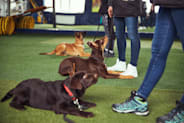
So my puppy is being very stubborn with training. Can't spank him or put his nose close to his messes without him screaming blood murder. Can't discipline or he yelps nd trys to run. He does not listen to anything or anyone. I need help please.

I just got my 8 week old Shihtzu yesterday and she had a few accidents in the house and I try to correct them every chance i get but her poop and pee schedule is weird. I cant tell when to take her out because she just pees and poops at different tim
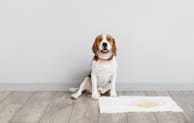
My 3 month old puppy eyes have been red for awhile but she shows no sign of sickness very active just urinate a lot and she doesn't lick her private area as a indication of a UTI can u help
How could i make a haski dog pee in a certain place?,he is 50 daya and verry stubborn
How can i stop the puppy from peeing and pooping in the house?
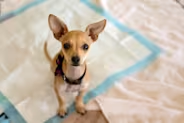
Here's the thing, my puppy can hold her pee for maximum 2-4 hrs. But when she is out of her cage or leash she pees every 15 min and she pees a lot. How do i train her?
My puppy is being potty trained so we take her out every 30 minutes or less. Although she goes outside she comes inside and almost immediately pees or poops on the floor. Why is she going so often and right after we walk her?
My four month old puppy was pretty much potty trained when suddenly she started peeing every where again.
How often would a 10 week old puppy need to go out to pee, especially at night? When could the time be extended?

Book an appointment with the pros – our expert vets are here to help.
