


How can I safely heat my hedgehog's cage with a heat lamp?
Updated On September 23rd, 2025
Pet's info: Small Animal | Unknown - Small Animal | Male | unneutered | 1lb
What is the best way to heat hedgehog cage with lamp?
3 Answers
Most Helpful Answer

Published on June 28th, 2018
Thank you for your question! My preferred method for warming a hedgehog cage is to use a ceramic heat bulb. They are sold in the reptile section of most pet stores. The reason that I prefer this type of bulb is that they only emit heat, and no light, so Quilliam's day/night cycle will not be affected. Many of the brands will also have a chart on them to assist you in what wattage you need from the bulb, but you will need the distance from the bulb to Quilliam (aka the height of the cage) as well as your desired temperature in order to use the chart (temperature recommendations for hedgehogs are 70-80F depending on what care sheet you are using). I would also recommend monitoring the temperature in his cage once you have added your heat bulb to ensure that it is within the desired range. This can be performed with a digital thermometer - these are also often found in the reptile section of most pet stores. I hope that helps to answer your question, and good luck!

1Pet Parents found this answer helpful
Related Answers from Veterinarians
-
Published on October 19th, 2018
Minimum cage size is 4 square feet for one hedgehog. Multilevel cages are fine, however be sure ramps are enclosed to prevent falls. Hedgehogs have poor eyesight and can walk off the side of a ramp. A cage should have a sleep/nest area, play area, feed area, a hide and an exercise apparatus. As long as the room is at least 72 F, supplemental heat is not required. You can use a ceramic heat emitter (CHE) which will produce heat without light if temps drop below that. Use a thermometer to make sure temps do not rise above 80 F.
1Pet Parents found this answer helpful
-
Published on October 25th, 2017
Room temperature between 72 F and 80 F is acceptable for hedgehogs. Ideal temperature is 74 F to 78 F. If temperatures drop too low for too long, your hedgehog may attempt hibernation. You can raise room temperature, use a heating pad (make sure it has a rheostat to prevent high temps) or use a CHE (ceramic heat emitter). If you choose a pad, wrap it in some towels and secure the cord against chewing. If you choose a CHE, make sure Santiago can't reach it. A thermometer is recommended to monitor temperature whenever using an external heat source.
1Pet Parents found this answer helpful


I am going to get my hedgehog a heat light. What kind is best? I know that they don't need them but I am wanting to get her one. Also what do hedgehogs need in their cages? How big should the cages be? Are multi-level cages ok? Pixie is almost two. T
Hello , I got a hedgehog some weeks ago. He is on my room and it is kind of cool. I visited some blogs and they give some tips to keep them warm so, I what to know if he needs something like a ceremic bulb to keep his temperature ok or another thing.
I am getting a hedgehog and have been told to get a small enclosed space to put in the cage for sleeping. Recommendations???
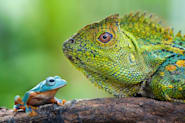
i got a leopard gecko today and i was scared that during the night he’d get too cold, i’m having trouble keeping the temperature around 80-90. i have a day light on it already. so should i put a night red light on him to keep him warm even though he
My hedgehog has been acting weird ...... he has been awake at random times of the day and even fell asleep outside of his cuddle sack Is something wrong?
I have seen some articles that say overhead heat is best but I've also seen some that say it under tank heating is best where do you stand? The only thing they seem able to agree on is that heated rocks are bad

I have a heat mat that ranges from 88-90 degrees for my leopard gecko but I know it can get pretty cold in the House can I use a (CHE)? If so how many watts is it recommended so my leopard gecko won’t get burn

We use a red heating lamp at times for our poodle. Is it okay?
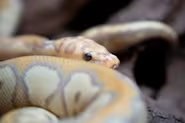
I have a pastel ball python and I was wondering how many watts I need to get for a basking spot in a 20 gallon tank and he will be turning a year old in september
Whay can i do about my hachling iguana over heating

Book an appointment with the pros – our expert vets are here to help.
