


Why does my dog pee on the couch only when I leave him alone?
Updated On September 23rd, 2025
My dog will not stop peeing on my couch when he is alone. It is the only place he pees in the house. If we block the couch with boxes before we leave he does not pee anywhere else. But if we leave it unblocked and leave the apartment, even for just a minute to check the mail he will pee on it. He always alerts us when we are home and he needs to go outside.
4 Answers
Most Helpful Answer
Published on December 29th, 2016
The most common cause of housetraining accidents like this that only occur when you're not home is separation anxiety - so I suspect that your dog may be quite stressed and anxious when you're gone. If you're unsure, you can set up a video camera to record him the next time you go out - it's usually quite easy to tell based on the video if this is an anxiety-related problem or not. I would suggest leaving a special long-lasting treat of some kind for him every time you leave the house, such as a Kong toy stuffed with peanut butter. This will help to keep him busy and encourage him to settle, and over time will help to decrease his anxiety by giving him something to look forward to when you leave. You can also try a DAP pheromone collar along with a natural calming supplement like Zylkene or Composure. If these things don't help, I would recommend taking your dog to the vet for a check-up to make sure that there is not an underlying medical issue contributing to the problem. You can also discuss the possibility of prescription anti-anxiety medication for him if needed.

1Pet Parents found this answer helpful
Related Answers from Veterinarians
-
Published on May 14th, 2018
It can still be anxiety. He may get anxious or upset when you are home but not with him. I would use a crate when you are going to be in another room without him or talk to your veterinarian about anxiety medication to see if that helps. Thank you for using Petco Pet Education Center, formerly Petcoach.
1Pet Parents found this answer helpful
-
Published on August 8th, 2018
Thanks for using Petco Pet Education Center, formerly Petcoach. This is so frustrating and I feel for you! This is clearly a behavioral problem rather than a medical one. To be honest, I’d recommend moving the couch to another room and then shutting the door and keeping Sirius out for a few weeks. Hopefully, that stops the problem, and breaks the cycle, though he may still decide to try on that couch any time he is able. Eventually you may even want to consider getting rid of the couch, depending on how it’s going. Best wishes to you and Sirius.
1Pet Parents found this answer helpful
-
Published on September 7th, 2017
• Practice leaving. You want your dog to trust that you are coming back and stay calm while you are gone. Practice leaving for small incriminates of time, even if just closing the door for a moment at first, and rewarding your dog for remaining relaxed. • Minimize “Goodbye” and “Hello.” To teach your dog that leaving and arriving is not a big deal, it is helpful to not draw attention to the fact that you are leaving or have been gone. • Give distracting treats and toys. Give your dog a positive distraction with long- lasting tasty treats approximately 20-30 min prior to your departure that will occupy him until after you have left. For example, a peanut-butter-and-kibble-filled Kong®. Also, provide plenty of chewable toys for your dog’s entertainment while you are away. • Leave on the radio/television. Some dogs may be comforted by background noise. What can I do if my dog already has separation anxiety? Treating an established case of separation anxiety will require the guidance and help of your vet. The road to recovery takes time and patience, but with the right tools you and your dog can both lead a less stressful life. It is very important that you visit with your veterinarian. Your veterinarian will help you formulate a specific plan to help reduce your dog’s anxiety and build his confidence. Things your vet may recommend are: Behavioral exercises SPECIFIC for you and your dog. Anxiety-reducing medication. These medications will not cure your dog; however, they can alleviate his anxiety enough so that he is able to learn new behaviors. An examination to look for underlying medical conditions.
1Pet Parents found this answer helpful



My dog recently has started to have accidents all over the house everyday but only when someone is in the house.When he is alone he does fine.We take him out a fair amount but nothing helps.What should I do?
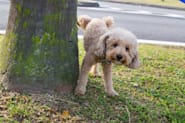
There is one couch that my dog pees on repeatedly, even if he’s just been out. It’s not an accident — he just does a little squirt rather than emptying his bladder. Why does he do this and how can I get him to stop? I clean it with an enzymatic clean

My treeing walker coonhound is almost 4 months old and he still has some accidents inside sometimes but overall he's been doing very good with housebreaking. Except.for. the. COUCH. He just randomly jumps on it all of a sudden and just lets go. Not a

So my dog will be outside and go to the restroom and everything if I put him inside the house while I'm still outside even if it's 5 min he will pee kinda like he is mad at me for leaving him same with him in his playpen he always pees in it as soon

We rescued a dog about three weeks ago. He just turned two years old in August. whenever we leave the house, no matter the length, he uses the bathroom in the house. Do you have any suggestions to help this problem
My dog just started peeing in the house everytime I leave which is not normal for him is this anxiety or an behavior he only does it when I’m gone
Hi! whenever i leave a room without my dog and closes the door behind me, (he doesnt do it if i dont close the door and he doesnt follow me everywhere) my dog pee or shit on the floor. BUT i doubt it's anxiety because i can leave my house without him
My dog has been potty-trained since she was 3 months old, but she's suddenly peeing on my sofa. I washed everything (including the sheet n cushions) , and the moment I put them back, she couldn't wait to pee on it again. What may be going on? Thanks!
My dog is 8 month old he's doing good with his potty training but when left alone he chews chairs and wees and poos on floor even though 3 puppy pads are left out is this normal at this age and how can I stop it
My dog pees and poops on the carpet when we leave and at night . We have tried everything and she finds her way out . Metal cage-rips gums and teeth out, mesh cage chews her way out, kitchen with a gate chewed base boards has to have wood slivers rem

Book an appointment with the pros – our expert vets are here to help.
