


Help! My new kitten won't stop scratching and biting me. What to do?
Updated On September 23rd, 2025
We adopted a 3 months old cat 3 weeks ago. She was born at home, never been to the streets. We fostered two cats before, a Bombay and a Persian mix. We were okay so we adopted one. Didn't want to shop, wanted to adopt. So the breed we adopted is found a lot in the streets of my country. A mix of African wild cat and Europe wild cat. And my problem is, scratches and bites. She scrathes me so bad. I tried new toys, saying ''no'' with a calm voice, ignoring her. Nothing works. I am so tired of it.
3 Answers
Most Helpful Answer

Published on December 21st, 2017
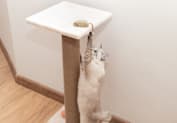
Hello, sorry to hear about your cat. She is very young still, so managing her scratching and biting will be crucial in this stages of life before she gets bigger and her scratching could become more damaging. Here are some tips you can follow to decrease the incidence of scratching. Hope this helps and best of luck. Why do cats scratch? Scratching is a normal behavior that aids cats in the marking of their territories in the form of scratch marks. Scent glands in their paws leave olfactory clues for other cats to alert them to their presence. Cats also find it pleasurable as a means of exercise and stretching. Scratching also allows cats to keep their claws healthy and shortened. Unlike dogs, a cats’ claws do not exfoliate evenly from the end; rather they peel off in layers like an onion. What is inappropriate scratching? Inappropriate scratching is ultimately determined by the owner, but is generally directed at furniture, screens, carpets and rugs and other items that the cats finds suitable. What can I do to prevent this? The easiest way to prevent severe damage is to trim your cats nails every 2-4 weeks. It is best to begin this process when the cat is very young, as they will become more accustomed to this procedure. However, older cats can learn to tolerate it as well. Another excellent method is to provide them with a suitable scratching substrate. As with nail trimming, this is also best started at an early age before the scratching behavior begins, but older cats will also generally accept such items as carpet or sisal fiber scratching posts or corrugated cardboard. For more options, you can visit your local pet store or make your own from their preferred scratching material and a supporting board of wood. My cat is ignoring the scratching post. How do I get him/her to use it? Place the item in the areas that your cat(s) enjoys scratching. You can entice the cat to use the item by rubbing or sprinkling with catnip. If your cat insists on using the wrong scratching surface, guide your cat to the correct site. Once at the post, you can start petting and scratching your cat while placing their feet on the surface for encouragement and stimulation of the natural kneading motion. Remember to reward your cat for its good behavior!

1Pet Parents found this answer helpful
Related Answers from Veterinarians
-
Published on
My cat still enjoys his/her favorite areas. How do I get him/her to stop? Ideally you would prevent access to that area by covering the area with things unpleasant to your cat such as double-sided tape, aluminum foil, or double-sided sticky tape. Cats also tend to have aversions to certain odors like citrus, so use of a lemon- scented spray can deter your cat and leave your home smelling fresh. If you catch your cat in the act, you can also calmly, and with no fanfare, bring the cat to the preferred post and reward lavishly there. If that is not possible, try to use remote punishment not associated with you to distract your cat. One option is to spray with a direct stream of water. Direct punishment, such as by you telling them “no”, will result in your cat not scratching when you are present, but does not stop them from scratching when you are gone. A recent development in cat behavior is a product called Feliway®. This is a feline facial pheromone that works on the premise that it will decrease your cats’ need to mark, but instead mark with its cheek. It has been used for urine marking specifically, but can be tried for claw marking. For more information this, talk with your veterinarian. What if my training efforts have proven ineffective? If your cat remains resistant to changing the locale of their scratching, a way to prevent more damage to your belongings is to apply nail covers such as Soft Paws ®. Soft Paws ® are lightweight vinyl caps that cover your cats’ claws. They can be applied by yourself at home, or if you’re more comfortable you can have your veterinarian apply them for you. They need to be checked weekly and replaced as necessary. Also, please remember that if your cat wears them they should not be allowed to go outdoors for safety reasons. I’ve heard about declawing, is this an option? If all other alternatives have been exhausted, declawing is an option. If you are contemplating this decision, please discuss your surgical options with your veterinarian so they can explain all that the procedure entails, possible complications, as well as new advances in pain management.
0Pet Parents found this answer helpful
-
Published on November 14th, 2018
She may need to play for longer periods of time to get tired out before you stop playing, or you may need to distract her with an appropriate toy just before you stop (a big stuffed animal might work). Cat scratches are much less likely to cause problems than cat bites, but you should check in with your physician if you have concerns. It also sounds like your cat might need some more scratching posts to use - I’ve also had some success with a product called Feliscratch that can encourage cats to choose a scratching post/pad over curtains and furniture. Clipping her nails can help reduce injuries in the meantime - for young cats I recommend clipping one claw a day for several months so they get very used to having their paws handled.
1Pet Parents found this answer helpful



We adopted a 2 and half year old female cat from a shelter about 3 weeks ago. Everything was going well (she eats well, uses her litter box with no problems and we clean after each use, and is playful) until the past few days when she started biting
My cat has developed a way of playing with us by biting and scratching (climbing our legs, back...) us. She used to do it in a way that didnt hurt but niw her teeth are bigger and it really hurts. How do we stop this behaviour? Is it normal? She has
I'm in need a new method of training my kitten. Spray bottle won't work a bit. He's a wild one, always biting and scratching

My kitten is extremely aggressive biting and scratching. Doesn't care if squirted with water or out in his kennel for a time out. When punished with water turns around and attacks our legs. If you try to pick him up he scratches and bites. Sometim
My last kitten used to bite me a lot and it would really hurt I'll soon be getting a new kitten and I want to know how can I prevent him from bitting me or anyone else?

Hi my kitty is showing some signs of bad behavior. She is scratching the furniture, I've bought her a cat tree and a craving post also I've praised her for using it she still scraches the couch. And she doesnt let anyone pet her she will claw you a
Hi, my cat has been biting me a lot. I want some tips on how to stop her from biting and scratching. She is 2 months old and very hyper.
We have a kittenof 15 weeks, she is very playful. When it's just my girlfriend and her, she's fine, she will lay on her lap and relax. But when I am about. She turns into a devil cat with scratching and biting, please help :(
My cat attacks people without a reason and he doesn't do it in a playful way.He bites and scratches really hard that my skin bleeds.He does this without a reason and i cannot predict when he will attack,he attacks even when he purrs.I tried to put hi
How can I calm my kitten. He is very aggressive for his age. Is it because he used to be abused by the previous owner. I have had him since he was less then 2 months old. I have played with him care for him and treated him as my own. Is their a type

Book an appointment with the pros – our expert vets are here to help.
