


Cat has scabs, itching. Miliary dermatitis? What to do without a vet?
Updated On September 23rd, 2025
Pet's info: Cat | Mixed Breed | Female | spayed | 4 years and 5 months old | 10 lbs
My cat has scabs all over her body, with excessive licking and scratching but no sighns of fleas. We feed her all Natural food and she always says inside. We do not let her go outdoors. We are thinking of buying some kind of ointment or spray to put on her but wasn't sure if that's a good idea. We are a little tight on money at the moment so we aren't able to take her to the vet. We are thinking she has miliary dermatitis. What should we do?
5 Answers
Most Helpful Answer

Published on September 5th, 2017
Hi there and thank you for your question on Petco Pet Education Center, formerly Petcoach! When you are petting her and your feel little seeds or what feels like little millet seeds, then it is very possible she could have miliary dermatitis. The #1 cause of military dermatitis is actually an allergy to fleas. It is only takes one flea to induce a flea allergy and the adult fleas can be hard to spot! Eggs and larva can be hard to see as well. Fleas find cracks and crevices to enter your home making household cats susceptible to acquiring fleas. If going to a vet is not an option, you can try bathing her in dawn dish soap (that will get rid of the adult fleas). You can then purchase an OTC flea treatment and preventative product such as Frontline Plus or Advantage to use monthly to ensure your are taking care of the entire life cycle of the flea. If the itching does not subside in a few weeks with the flea preventative, then it may be possible she has another environmental allergy or a food allergy, but I would rule out an allergy to fleas first. :) Thank you so much for your question and I wish you and Ishiban the very best!

4Pet Parents found this answer helpful
Related Answers from Veterinarians
-
Published on June 4th, 2018
While it is important to treat Princess for the fleas, you will also need to treat the environment to prevent a reinfestation (https://www.petcoach.co/article/flea-control-and-prevention/. The dermatitis looks fairly severe and it may not resolve without antibiotic treatment.
1Pet Parents found this answer helpful
-
Published on April 7th, 2017
Oh no, poor Stokely! Feline miliary dermatitis commonly results from an allergic reaction. The most common cause is an allergy to flea bites, so make sure he is up to date on his flea treatments. If he's not, I can give you a flea treatment program. First, I would give him Capstar. It's a one time pill that starts killing fleas within 30 minutes. Then follow up with a spot on treatment, such as Advantage or Revolution. This is a treatment that has to be used once a month. You will also have to disinfect the environment. Wash his bedding in hot soapy water, and vacuum the furniture and carpet surfaces. You can use a spray to kill fleas in the house, such as Indorex, or a flea bomb would work well to kill the fleas in the home. I would have have Stokely seen by a vet. Miliary dermatitis may also require corticosteroids to treat itchiness and discomfort, which the vet can prescribe. In addition, the vet can determine what is causing the dermatitis and can treat the inciting cause if he is up to date on his flea treatments.
2Pet Parents found this answer helpful
-
Published on December 9th, 2017
Hi and thanks for using Petco Pet Education Center, formerly Petcoach! Sorry to hear about Frank. Sounds like he is suffering from the following- Small scabs which can cover the head, neck, back, etc are indicative of a condition known as Feline Miliary Dermatitis. Most times there is hair loss and increased itching also. The causes are many including fleas, ticks, mites, allergies, skin infection, immune-mediated problems, etc. Unfortunately, there really isn't much you can do at home to address the condition and intense itching. Just make sure that the flea situation is under control, treating all pets and treating all indoor environmental areas. To break the flea cycle, typically this can take up to 3 months of diligent attention. That allows enough time to get all of the life stages of flea under control. I would advise that you take Frank to your vet for a thorough history and evaluation (physical exam). Your vet can then advise either diagnostics (lab tests, skin tests including skin scrape, etc,) and/or treatment for this condition. This condition is treated with steroids (often by injection, long-acting), antibiotics, other allergy medicines, good flea/tick products, and many others depending on what your vet thinks is the inciting cause. Here is some information from a veterinary only website- Miliary Dermatitis Becky Lundgren (author) Cats can get a condition called miliary dermatitis, which is the descriptive term used for a cutaneous reaction pattern of focal (localized) or generalized small papules (bumps) or crusts. Miliary dermatitis is not a specific disease. It is secondary to many other diseases. Causes of miliary dermatitis include insect (flea, mosquito, ear mite, etc.) bite hypersensitivity, atopy (sensitivity to aero-allergens such as pollen, mold, house dust mites, etc.), adverse reaction to a food, bacterial superficial folliculitis (inflamed skin follicles), dermatophytosis (fungal disease), feline scabies, mast cell tumors, and pemphigus foliaceus. Flea hypersensitivity is the most common cause of miliary dermatitis. Diagnosis of the root cause of miliary dermatitis may require cytology, skin scrapings, insect control trial, elimination diet, fungal culture, and biopsy. Treatment is based on eliminating or treating the root cause of miliary dermatitis. Here's a client information guide from Univ of FL veterinary school vetmed-hospitals-smallanimal.sites.medinfo.ufl.edu/files/2011/09/Skin-Diseases-in-Cats-client-guide.pdf Good luck with Frank. I hope this resolves quickly. I just treated my outside cat Opie for this particular problem.
1Pet Parents found this answer helpful
-
Published on March 2nd, 2017
The treatment depends on the cause. The most common cause of military dermatitis is an allergy to flea bites. The cat will need to be treated for fleas, and then will need steroids or antihistamines to treat the allergy. It can also be caused by parasitic infection such as cheyletiellosis, which then requires medicated baths, dips, or sprays to treat. Should it be caused by a food allergy, the vet may prescribe an hypoallergenic food trial. I would have Ashley seen by a vet to have the cause of her military dermatitis diagnosed so she can be prescribed the appropriate treatment.
3Pet Parents found this answer helpful



I recently went to my fathers house and noticed that his cat is suffering horribly. She is long haired. Her hair is falling out, she has bloody scabs, weight loss and she itches/licks excessively. There are flakes in her fur, and it is very red and r

I believe my 8 year old male cat has miliary dermatitis. He is an indoor cat and we also have an 8 year old female dog. Can you recommend a home remedy for the dermatitis. And a recommendation for flea prevention for cats. Thank you very much.
Mittens has been getting scans on her back for almost at year. She is not and flea free. I change up food and litter and nothing has changed. I took her to the vet once and the vet said it was probably the cats playing but the scans have spread all o

My 8 year old cat has a rash all over her. I've tried to change the food that I am feeding her. She started vomiting, but recovered quickly. She is constantly scratching, and I am finding hair attached to a scab. What can I do, seeing as I am financi

Zoe was a rescue kitten, adopted in ~2004. Blue fur, silver muzzle, green eyes. Always had danduff & itchiness on her back to the base of her tail. Started ripping out hair on her back ~4-5 years ago, & progressed to stomach & sides. Antihistamines d
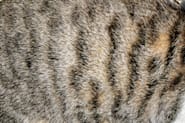
what my about 6 or 7 year old female fixed cat has. she has had fleas and been treated that was about 2-3 months ago fleas are gone but now for the last 3 weeks she has been constantly licking and acts like she's getting bit sometimes and she has l

My cat Lily has red bumps and scabs going from the middle of her back and going down her spine to her tail. I have never seen this before in the 10 years since she kidnapped me and moved herself into my apt. I don't see any fleas but her fur is extre

I have a female 4 year old tuxedo cat. She cleans herself a lot but lately she does it nonstop and scratches so much she has a ton of scabs on her chin and neck. She doesn’t have flees. I’ve checked Several times. Secondly, she sleeps in my room wit
Cat has scabs all over no hair loss and absolutely no fleas. He does have an ear that is gooky and you can hear the stuff that is in it. Any ideas? Food is no grain.
3 year old Russian blue, fur on his midsection is thinning , skin has small scabs and it's very sensitive , he doesn't like being touched around the area with scabs. His appetite is normal , he's friendly and sociable , is this something i can trea

Book an appointment with the pros – our expert vets are here to help.
