


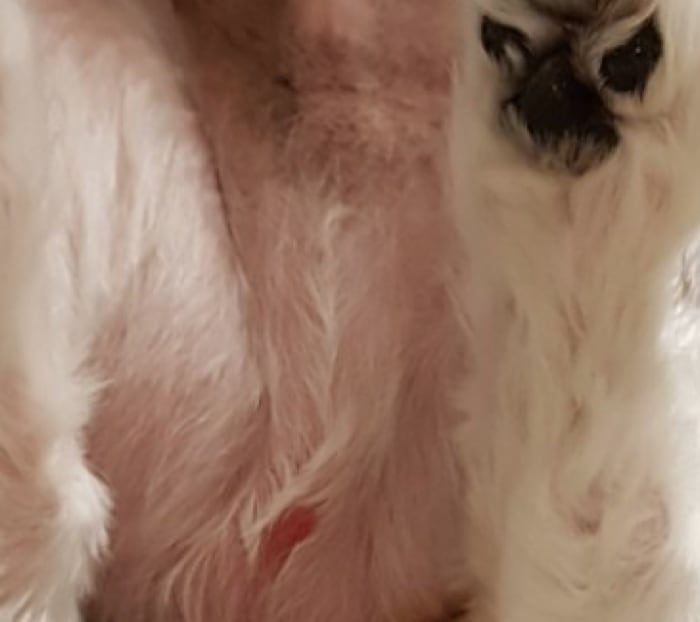
My dog has a red lump or blister near his anus. Is it serious?
Updated On September 23rd, 2025
Pet's info: Dog | Mixed Breed Small (up to 22lb) | Male | neutered | 13 lbs
What is this lump/ blister near my dog's anus?


4 Answers
Most Helpful Answer

Published on July 28th, 2017
It's a little difficult to tell from your picture alone - being able to examine and touch a lump in person makes it much easier to determine what it is. This could be a skin tumor, a small abscess or inflammatory nodule, or a lesion from something like contact hypersensitivity. I would recommend having this lump examined by your veterinarian since it looks red and possibly like there is discharge. If he is licking or chewing at the lump you should put an e-collar on him until you can see a veterinarian. They may know what it is after being able to examine it or may recommend taking an aspirate sample using a small needle to look for cells under the microscope.

2Pet Parents found this answer helpful
Related Answers from Veterinarians
-
Published on April 22nd, 2018
This red lump needs to be checked and analysed as there are many conditions and types of tumors that could look like that. take him to the vet, they will perform a fine needle aspiration on the growth and send it to the lab for analysis. when the result comes, the vet will advise what needs to be done according to the diagnosis.
1Pet Parents found this answer helpful
-
Published on October 30th, 2016
Pictures can only be shared within private consultations, alternatively you can upload a picture to your profile an ask the question again. What you are describing sounds like a possible allergic reaction, if it has been there for more than 48 hours I would recommend taking jack to the vet in order to get it checked and treated.
1Pet Parents found this answer helpful
-
Published on March 18th, 2019
Yes, I would be concerned because any lump in a senior dog could be malignant. It could also be benign or a cyst. Any suspicious lumps should be examined by the vet. The vet can perform a test called a fine needle aspirate on it. To do this, the vet sticks a small needle into the lump to get a sample of its cells, and examines the cells on a slide under a microscope. It's usually painless to the animal, and relatively quick to perform. Once the cause of the lump is diagnosed, the vet can discuss treatment options if needed. I'd give Sasha's vet a call in the morning to make her an appointment. Best of luck.
1Pet Parents found this answer helpful



So my doggy,pitbull x sharpei almost 4 years old has a red pea size lump just above his anus and the skin above looks swollen,what could this be? And what can I do to help til I can get him to the vet? Please and thankyou
I just noticed a bluish bulge/lump near my dogs anus with blood on it, I believe it's a hemhorroid but would like to know for sure, It doesn't seem to be causing her pain or discomfort, and I would like to know what I can do for her (at home as well

Is this a perianal adenomas? This is located in the bottom left corner of his Anus. Vet said his anal Glands aren’t swollen or impacted

My Great Dane lab mix looks like he has a blister or something on his butthole... idk if I need to take him in or not ? He is 3 years old.
Hi and thank you for helping us today. I noticed my dog Jasmine has a swollen red bump beside her rectum this morning. It looks like it has gotten worse over the last couple of hours. I scheduled an appt with a vet tomorrow but not sure if I should c

I noticed a tiny lump above my dog's anus over a month ago, it recently grew very quickly. Any idea what it could be and/or how concerned I should be? I'll be taking her to the vet asap but I can't even call for an appointment until Monday and am jus
Hello, My dog's anus is bleeding. For the past few months, I noticed that he's been having difficulty defecating. I noticed a small bump near his anus before. I want to bring him to a veterinarian but my mother does not allow me to. I am worried and
Hi, my dog is 2 days that has this bump on his butt. It is big and red..I noticed it 2 days ago..what can it be ?
My dog has suddenly got a lump near his anus. Is this serious, what to do about it?
I was giving my dog a bath and discovered he has a large bump underneath his anus that’s bright pink and I’m not sure what it is or if I need to take him to the vet, its only on his right side but it’s not a ball just a huge bump.

Book an appointment with the pros – our expert vets are here to help.
