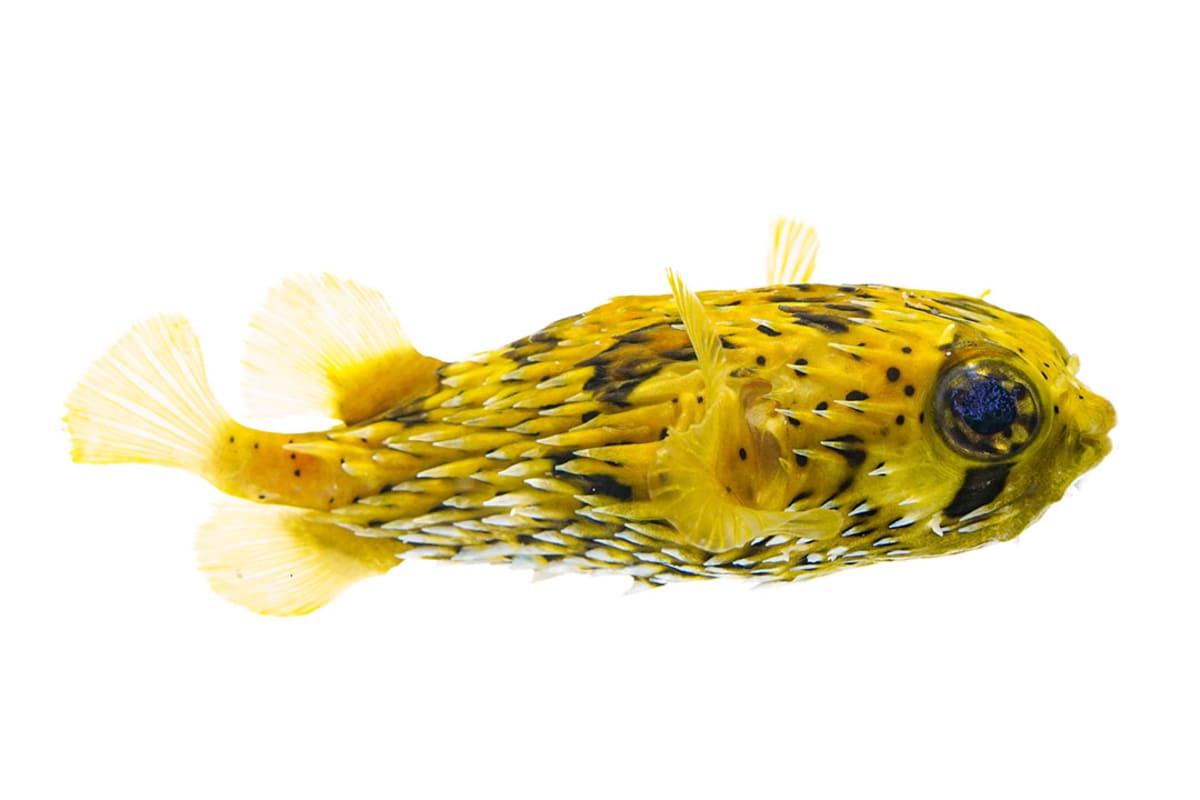
Includes marine puffer species such as:
- Valentini puffer
- Porcupine puffer
- Dogface puffer
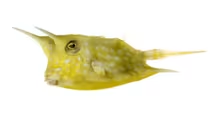
- Spiny box puffer
- Stars and stripes puffer
- Spotted puffer
- Honeycomb puffer
- Blue spotted puffer
- Bennett’s sharpnose puffer
- Leopard sharpnose puffer
Typical appearance and behavior
Pufferfish typically:
- Have fused, beak-like teeth
- Inflate when they feel threatened; can be aggressive
- Eat smaller fish and invertebrates
- Inhabit the middle levels of the aquarium
- Can move their eyes independently
Some pufferfish can change their color to match their environment.
Characteristics
| Care Difficulty | Beginner to advanced, depending on species |
| Average Life Span | Up to 10 years with proper care, depending on species |
| Average Adult Size | 3.5–25+ inches long, depending on species |
| Diet | Carnivorous |
| Minimum Habitat Size | 29+ gallons, depending on species |
| Water temperature | 74–80°F |
| Specific gravity | 1.020-1.025 |
Habitat
Habitat size
- Keep in an appropriately sized aquarium. A minimum of 29 gallons is recommended for smaller-sized adult puffers. A much larger aquarium will be needed for larger species like an adult porcupine puffer.
Building your habitat
Water health: Provide proper filtration to ensure optimal water quality to help maintain health; slow to moderate water circulation, depending on species, will mimic water currents found in the puffer’s natural habitat
- Stable water quality (pH, ammonia, nitrate, nitrite) and water temperature are critical to the health of aquatic life; if you are unsure of your water quality, bring a sample to Petco for free testing
- A protein skimmer can help maintain great water quality and high dissolved oxygen levels
- An aquatic heater should be used to stabilize water temperature, ensuring it does not fluctuate more than +/-2 degrees in a 24-hour period
- The specific gravity should remain stable; do not allow specific gravity to fluctuate more than +/-0.001 in a 24-hour period
Décor - Provide rock and décor for hiding places, as well as plenty of open room for movement
What do puffer fish eat?
A well-balanced puffer diet consists of:
- Chopped squid, clams, shrimp and krill
- Carnivorous pellets, freeze-dried and frozen foods
- Shelled foods, like mussels, to help wear down larger puffers’ continuously growing teeth
- Varied foods to ensure proper nutritional balance
Things to remember when feeding your puffer:
- Feed 1–2 times a day, no more than fish will eat in 1–2 minutes
- Thaw frozen food before feeding
Puffer care
Water care: Maintaining great water quality with regular water changes and adequate filtration is important to help keep your puffer healthy
- Daily: Check filter, water temperature and other equipment
- Weekly: Test water quality at least once a week
- Weekly to monthly: Change 10–25% of the total volume of water every two to four weeks, or as needed; change filter media monthly
Avoid unnecessarily scaring or teasing your puffer to get it to puff up; this is extremely stressful on the puffer
Avoid overcrowded conditions, which are a major cause of stress and disease
Maintain good water quality with regular water changes and adequate filtration
Where to buy
Various puffers are available for purchase at Petco online and in store; availability varies by location. If visiting your local location, please call ahead to check availability.
Supplies
- Appropriately sized aquarium
- Appropriate food, dry and frozen
- Décor
- Marine aquarium salt
- Water conditioner
- Filter
- Water test kit
- Full-spectrum lighting
- Net
- Thermometer
- Protein skimmer
- Marine substrate
- Heater
- Refractometer
Tank mates
Introduce new inhabitants to the aquarium gradually. Depending on their specific species, puffers may be compatible with:
- Dwarf and large angelfish
- Blennies
- Clownfish
- Damselfish
- Eels
- Gobies
- Groupers
- Hawkfish
- Lionfish
- Pseudochromis
- Wrasses
Some may be compatible with other puffer species of different shapes and sizes, or with similar puffer species in a larger aquarium.
Health
Signs of a healthy puffer
- Eats vigorously
- Clear eyes
- Active swimming
- Regular breathing
- Bright, even coloring
- Fins completely intact and undamaged
- Free of parasites or disease
Red flags (if you notice any of these signs, contact your local aquatic specialist or veterinarian)
- Loss of color or appetite
- Spots or fungus on body or mouth
- Listlessness
- Erratic swimming
- Labored breathing
- Weight loss
- Cloudy eyes
- Frayed fins
Common health issues
| Health Issue | Symptoms or Causes | Suggested Action |
|---|---|---|
| Health IssueFin rot | Symptoms or CausesFrayed or disintegrating fins; the base of the fins usually reddens | Suggested ActionImprove water quality; consult your local aquatic specialist or aquatic veterinarian for treatment. |
| Health IssueMarine ich | Symptoms or CausesCysts on fins, gills, and skin; labored breathing, excess skin mucus or pale skin | Suggested ActionQuarantine fish immediately and use a commercial parasite remedy (freshwater dips can help dislodge the parasites); consult your local aquatic specialist or aquatic veterinarian for treatment |
| Health IssueBacterial infection | Symptoms or CausesCloudy eyes, open sores and/or reddening of the skin | Suggested ActionImprove water quality; use a commercial antibacterial remedy as directed; consult your local aquatic specialist or aquatic veterinarian for treatment |
| Health IssueViral infection (lymphocystis) | Symptoms or CausesWhite nodule growths on fins or body | Suggested ActionImprove water quality; consult your local aquatic specialist or aquatic veterinarian for treatment |
Notes and resources
Ask a Pet Care Center associate about Petco's selection of products available for the care and happiness of your new pet. All products carry a 100% money-back guarantee.
Because all aquatic life are potential carriers of infectious diseases, such as atypical mycobacteria and salmonella, always wash your hands before and after handling your aquatic life or habitat contents to help prevent the potential spread of disease.
Pregnant women, children under the age of 5, senior citizens and people with weakened immune systems should contact their physician before purchasing or caring for aquatic life and should consider not having aquatic life as a pet.
Go to the Centers for Disease Control at cdc.gov/healthypets for more information about aquatic life and disease.
The information on this care sheet is not a substitute for veterinary care. If you need additional information, please contact your veterinarian as appropriate.
FAQs
What do puffer fish eat?

Puffers should be fed a carnivorous diet of pellets and freeze-dried and frozen foods, along with chopped squid, clams, shrimp and krill. Larger puffers should be offered shelled foods, like mussels, to help wear down their continuously growing teeth.
Where do puffer fish live?
Marine pufferfish can be found in most warm tropical seas and ocean waters.
What is a puffer fish?
Puffers are uniquely shaped fish who belong to the Teraodontidae family (or the Diodonitadae family for the porcupine puffer). That have fused teeth that resemble a bird’s beak. They are well known for their ability to suck in water or air, allowing them to expand like a balloon.
Where can I buy a puffer fish?
Various puffers are available for purchase at Petco online and in store; availability varies by location.